Breaking Borders with Code: The Power of Internationalization (i18n)
Breaking Borders with Code: The Power of Internationalization (i18n)
Welcome back to CodeWithBotina. If you write code, your ultimate goal is for as many people as possible to use what you build. But what happens when the barrier isn't the performance of your app, but the user's language?
Today we are going to talk about a concept that separates local projects from world-class applications: Internationalization, or as we know it in the industry, i18n (because there are 18 letters between the 'i' and the 'n').
🌍 What exactly is Internationalization?
It's not just about running your text through Google Translate. True internationalization means preparing your software architecture so it can adapt to different languages, date formats, currencies, and time zones without having to rewrite the core code.
On a technical level, this usually involves:
- Extracting all hardcoded text from your UI.
- Using a system of dictionaries (usually
.jsonfiles). - Implementing a context provider that detects the user's browser language and serves the correct translations in real-time.
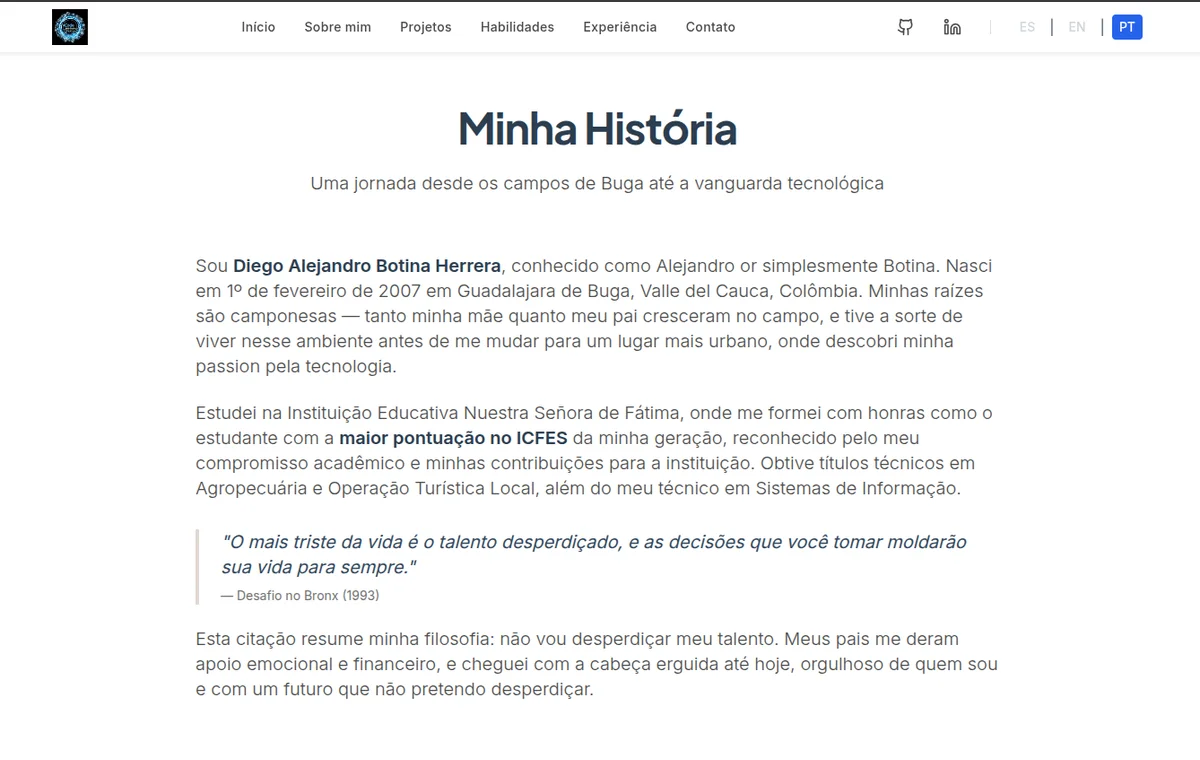
🚀 My portfolio now speaks 3 languages!
I've been applying these exact principles behind the scenes, and I am thrilled to announce that my personal portfolio has been fully internationalized.
Starting today, you can browse all my projects, articles, and experience in Spanish, English, and Portuguese.
👉 Visit the portfolio here: portfolio.codewithbotina.com
Implementing Portuguese and English wasn't just a technical challenge to ensure the UI didn't break with longer or shorter words; it was a necessary step to connect with the incredible developer community in Brazil and across the English-speaking world.
🛠️ Why should you implement i18n in your projects?
- Broader Reach: 70% of internet users do not browse in English. If your app is only in one language, you are leaving money and impact on the table.
- Professionalism: A portfolio or project that supports multiple languages shows recruiters that you understand scalable architectures.
- Accessibility and Empathy: Speaking to the user in their native language reduces friction and drastically improves the User Experience (UX).
If you use React, tools like react-i18next or next-intl are excellent starting points. In Flutter, the official flutter_localizations package works wonders.
What language is the project you are currently working on written in? Let me know in the comments and dare to take the global leap!
Coding for the entire world. See you in the next CodeWithBotina post.
Loading reactions...
Comments (0)
Loading session...
No comments yet. Be the first to comment.