Champions, legends, and technology: what the 2026 World Cup left us
A trophy for Spain, a farewell for Messi, a lesson for Colombia
Spain, world champions. Second star. Deserved, unquestionable, won with football that combined their characteristic possession with an unexpected verticality. This 2026 World Cup will go down in history not only for La Roja's title, but for being the stage where technology and football met like never before.
But before diving into the technical side, I want to pause on two moments that, for me, defined this tournament.
Argentina and Messi. Beyond the result, beyond the elimination, I want to say thank you. Thank you, Leo, for all those Sunday afternoons. For that football that is no longer played the way you played it at Barcelona. For me, the most complete player in history. And thank you to your teammates, for giving us afternoons of football we will never forget. Football is not just about winning; it is about moving people, and you did that.
My Colombia. Warriors, thank you. Once again, penalties cut our wings in the round of 16. It hurts. But this was the closing of a generation that gave us back hope. The belief that maybe yes, that maybe we could have gone further. It is clear that the national team needs drastic changes. But with the right direction, with someone committed to this long‑term project, I am sure we can surprise in the 2028 Copa América. And then we will see if Colombia truly has a chance in the 2030 World Cup.
That said, let us get to what many were waiting for: the technology.
VAR 3D: the silent revolution of the 2026 World Cup
The 2026 World Cup has been called the first "AI World Cup" in history. And for good reason. Technology was present in every aspect of the tournament: from teams' tactical preparation to assisting referees' decision‑making.
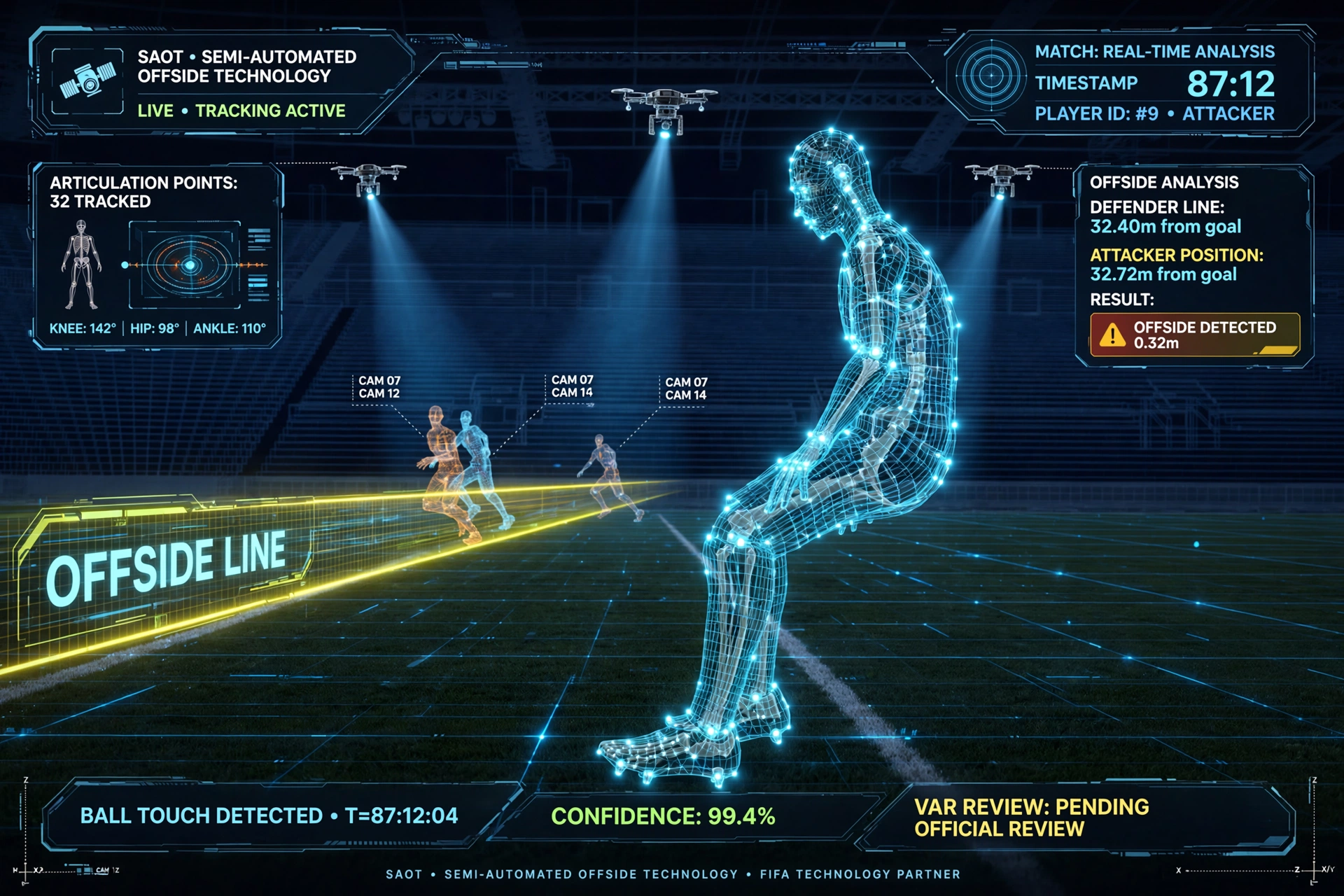
But if there is one innovation that sparked debate, it was the enhanced semi‑automated offside system (SAOT) with AI‑powered 3D avatars. The technology that, in the Colombia vs Portugal match, drew a millimetric line and determined that the tip of Davinson Sánchez's foot was offside.
Let us break it down.
What exactly is this new technology?
In simple terms: it is a system that turns every player into a millimetre‑precision 3D digital avatar to determine offside with unprecedented accuracy.
The process works like this:
Pre‑tournament 3D scanning. Each of the 1,248 players from the 48 participating nations underwent a full‑body scan in a special camera. The process takes about one second and captures "high‑precision" body dimensions. The result: a 3D model that reproduces each player's physique down to the smallest detail.
Real‑time tracking. During the match, the system tracks every player and the ball at all times.
Automatic alert. When the system detects an offside position, it sends a real‑time audio alert to the assistant referee's earpiece if a player is more than 10 cm ahead. This is a significant improvement over previous versions, which only notified from 50 cm.
3D replay for the final decision. When a play is reviewed, the "digital players" appear on the television broadcast, visualising the analysis process in three dimensions. VAR referees can rotate a fully rendered 3D scene to verify offside positions with what FIFA calls "scalp‑level" precision.
Who is behind this technology?
The technology was developed by Lenovo, FIFA's official technology partner for the 2026 World Cup. The partnership was signed in October 2024 at Tech World in Las Vegas.
Lenovo not only provided the hardware and infrastructure, but also developed Football AI Pro, a generative AI‑based analysis assistant made available to all 48 participating nations.
The project, called "Football AI", reflects the shared commitment between FIFA and Lenovo to modernise and democratise football through digital technology and AI.
Can this technology be manipulated?
This is the question many fans have asked, especially after controversial decisions like the offside call that ruled out Davinson Sánchez's goal.
FIFA's official response is clear: the system has multiple security and redundancy mechanisms to prevent errors and manipulation.
According to official information:
- The system is designed with multiple security measures that act as "failsafes".
- The main referee retains final authority over when to raise the flag and stop play.
- The referee can keep the flag down if they suspect a malfunction.
However, the technology is not infallible:
- It cannot detect offside in the tightest positions.
- It has limitations if players are on the ground or if several are very close together.
- It is only used for positional offside, not for subjective decisions like interfering with an opponent without touching the ball.
What has FIFA said about the rumours?
FIFA has been transparent about the limitations and technical incidents. In fact, during the World Cup there was a documented incident that raised doubts.
In Switzerland's draw against Qatar, no graphical offside animation was shown during the VAR review that validated a penalty. FIFA confirmed there was a "brief technical interruption" that prevented the graphical animation from being available.
FIFA explained that the animation was not available in either of the two situations immediately preceding the penalty decision. This incident, although isolated, shows that the technology can still have faults.
How does the whole system work?
The following diagram illustrates the complete flow of the refereeing system with the new 3D technology at the 2026 World Cup.
flowchart TD
    A["Pre‑tournament 3D scanning1,248 players scanned1 second per player"] --> B["Creation of digital avatarsHigh‑precision 3D models"]

    B --> C["Live match12 cameras track playersBall with sensor"]

    C --> D{"Offside position?"}

    D -->|Yes| E["Real‑time audio alertto assistant (>10 cm)"]
    D -->|No| F["Play continues"]

    E --> G["VAR reviews the playRendered 3D replay"]

    G --> H["3D animation broadcastto fans"]
    G --> I["Referee makes final decision"]

    style A fill:#e3f2fd,stroke:#1565c0
    style B fill:#e8f5e9,stroke:#2e7d32
    style C fill:#fff3e0,stroke:#ef6c00
    style E fill:#fce4ec,stroke:#c62828
    style G fill:#f3e5f5,stroke:#7b1fa2
Extended VAR: beyond offside
The 2026 World Cup also introduced other technological innovations that complement VAR:
Out‑of‑play technology
- A 3D system similar to the offside one determines whether the ball had completely crossed the line before a goal.
- A 3D animation is created, just like with goal‑line technology, showing the ball's exact position.
- The chip in the ball indicates which player last touched it.
Real‑time 3D replay for "line of sight"
- FIFA has expanded "Real‑Time 3D Replay" to make "line‑of‑sight" judgments faster and clearer.
- There are two virtual feeds, available to the VAR and viewers, replicating both goalkeepers' perspectives.
- This helps determine whether an offside player blocks the goalkeeper's view.
Referee View
- A lightweight video camera mounted on the main referee's head captures their point of view during matches.
- Lenovo provides a stabilised signal using its proprietary algorithm, correcting imperfections like excessive movement.
- It has been integrated live into the broadcast.
Q&A: what you need to know
Is the 3D technology infallible?
No. FIFA itself acknowledges its limitations:
- It cannot detect offside in the tightest positions.
- It struggles if players are on the ground or very close together.
- It is only used for positional offside, not subjective decisions.
- It can suffer technical interruptions, as happened in the Switzerland‑Qatar match.
Can a referee overrule the system's decision?
Yes. The main referee retains final authority over when to raise the flag and stop play. They can also keep the flag down if they suspect a malfunction.
What languages or technologies were used to build the system?
Although FIFA has not published specific details on the programming languages used, the system's architecture includes:
- AI and machine learning for player tracking and offside detection.
- Computer vision to process images from the 12 cameras.
- 3D modelling and rendering to create the animations.
- Ball sensors with an embedded chip.
- Cloud infrastructure to process data in real time.
Lenovo provided the complete technical expertise, using its hardware and applying AI in the avatar creation process.
What has FIFA said about the criticism?
FIFA has defended the technology as a significant step forward for accuracy and transparency. According to Johannes Holzmüller, FIFA's Director of Innovation:
> "This is useful for refereeing, but in the end it is also exciting for football fans, as we will improve the 3D replays broadcast, where the players really look like the players and it is immediately obvious which players are involved in the offside position."
Conclusion: technology at the service of football, but without replacing the human
The 2026 World Cup has shown us that technology can be a powerful ally for refereeing. The millimetric precision of 3D avatars, the speed of automatic alerts, and the clarity of the broadcast animations have brought football closer to the transparency that fans demand.
But it has also reminded us that technology is not perfect. It has limitations, it can fail, and above all, it depends on human interpretation. The referee is still the one who makes the final decision. Technology is a tool, not a substitute.
For Colombia, Davinson Sánchez's offside was painful. But it was also an example of how technology, in its current state, can decide matches by millimetres. And that, like it or not, is modern football.
References
- BBC Sport. (2026, June 2). World Cup 2026: Fifa adds new offside technology to help VAR. https://www.bbc.com/sport/football/articles/c232d34kkyzo
- BBC Newsround. (2026). World Cup 2026: Fifa to create 3D avatars of players to help with VAR decisions at tournament. https://www.bbc.co.uk/newsround/articles/c1dk4gv7eeqo
- FIFA. (2026, July 1). New innovations developed with Technology Partner Lenovo shine at the FIFA World Cup 2026™. https://vod.fifa.com/innovation/news/lenovo-world-cup-2026-technology-ref-cam-player-avatars-ai
- FIFA. (2026, June 3). Faster offside decisions, more stable referee body cams and more analysis opportunities for teams: how innovation is elevating the FIFA World Cup 2026™ experience. https://vod.fifa.com/innovation/news/offside-decisions-referee-body-cams-innovation-world-cup-2026
- FIFA. (2026, January 7). FIFA and Lenovo unveil multiple AI-powered innovations ahead of FIFA World Cup 2026™. https://ru.m.fifa.com/organisation/media-releases/lenovo-tech-world-ai-powered-innovations-world-cup-2026
- Vietnam.vn. (2026, July 18). Chinese AI technology to shine at the 2026 World Cup. https://www.vietnam.vn/en/ai-cong-nghe-trung-quoc-toa-sang-tai-world-cup-2026
- Pandaily. (2026, June 14). Lenovo Built the AI Engine Behind the 2026 World Cup — Here's How It Performed on Opening Night. https://pandaily.com
- OneFootball. (2026, June 17). FIFA explains lack of semi-auto offside images in Qatar's World Cup draw with Switzerland. https://onefootball.com
Loading reactions...
Comments (0)
Loading session...
No comments yet. Be the first to comment.