July says goodbye, August welcomes us: the state of mobile development in 2026
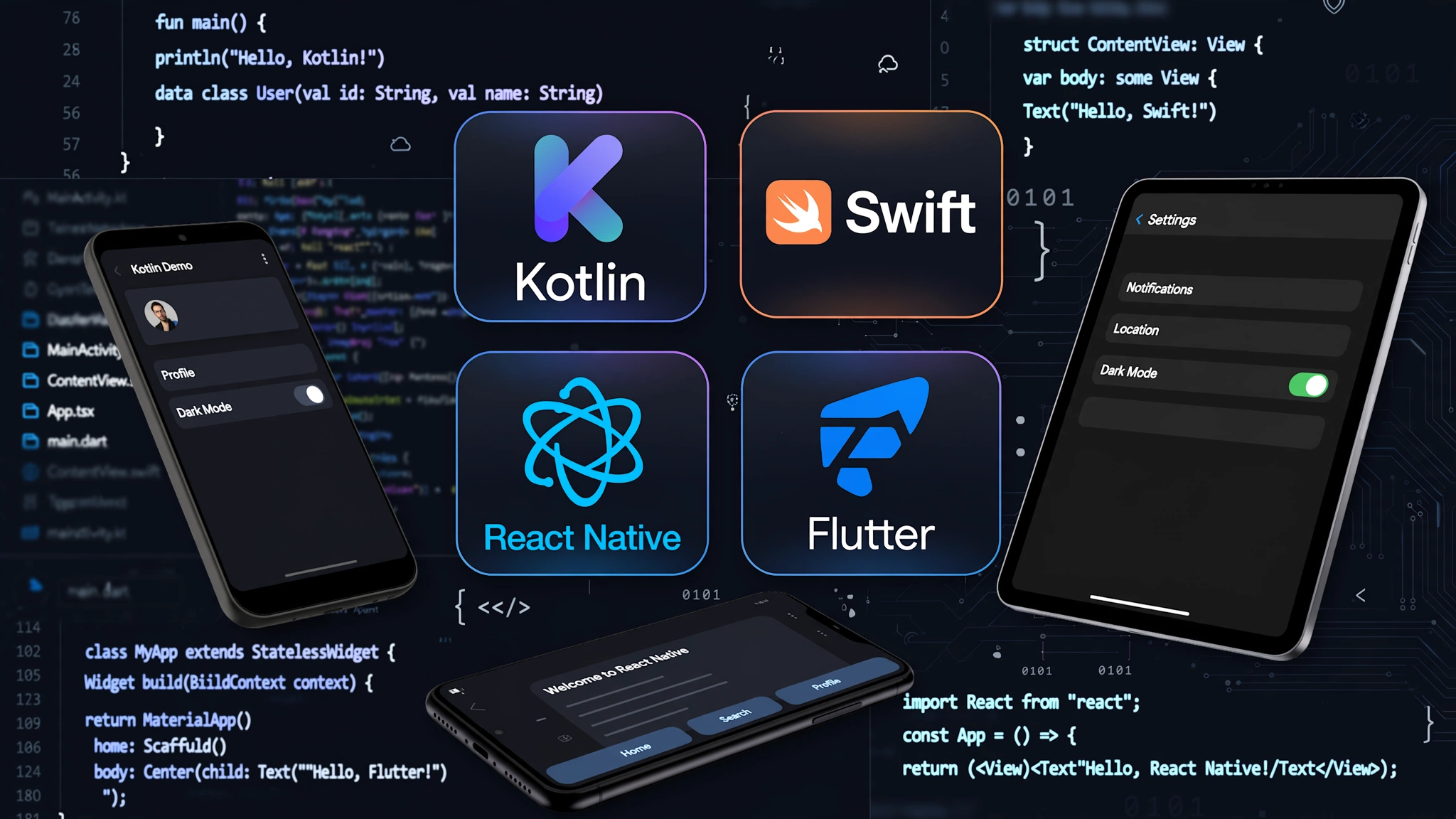
July 2026 leaves us with a clear panorama: mobile development is no longer what it was five years ago. The industry has matured, tools have consolidated, and artificial intelligence has ceased to be a promise to become a tangible component in the daily life of development teams. August arrives with a market where the question is no longer "which framework do I choose?" but "how do I integrate AI into my workflow and my product?"
This month that begins, more than 75% of mobile development teams are prioritizing the integration of AI capabilities into their applications. 5G connectivity, IoT and wearables integration, and augmented reality and voice interfaces are no longer experiments; they are user expectations. And in this context, the tools we use to build apps are evolving at a speed that few would have predicted.
Let's talk about what really matters: the languages, frameworks, and innovations that are defining 2026.
The king languages of mobile development in 2026
The language ecosystem for mobile development in 2026 is more defined than ever. There are two clear winners in the native world and an ecosystem of alternatives that are gaining ground.
Kotlin: the undisputed king of Android
Kotlin has consolidated as the default language for native Android development. Google officially declared it the preferred language for Android years ago, and by 2026, adoption is practically total. According to 2026 data, Kotlin reached 2.5 million developers worldwide. In the Top 1000 global applications, over 95% have already fully migrated to Kotlin or use a hybrid development model.
What makes Kotlin special is not just its modern, concise syntax, but its ecosystem. With Kotlin Multiplatform (KMP), the language has transcended native development to become a serious option for code sharing across platforms. Job posting statistics reflect its dominance: Kotlin appears in 46.6% of mobile developer job offers, with a projected salary of $136,000 per year for specialized developers.
Swift: the iOS standard that is not questioned
On the Apple side, Swift has no competitor. Since it replaced Objective‑C, it has become the native language for development on iOS, iPadOS, macOS, watchOS, and tvOS. In 2026, Swift is included in practically every popular App Store application. Its beginner‑friendly syntax and type safety have made it the favorite of Apple developers.
Swift appears in 35.8% of mobile development job offers, consolidating as the second most in‑demand language in the sector. And although Objective‑C has not completely disappeared, its use is increasingly limited to legacy applications.
Java and JavaScript: the veterans that aren't going away
Java is still present, mainly in the maintenance of legacy Android applications. Although it is no longer the first choice for new projects, it still represents 27% of job offers in the sector. Many companies with large, old codebases still depend on Java, and the transition to Kotlin, although recommended, is not always immediate.
JavaScript, for its part, remains the most used language globally with a 66% adoption rate according to the 2025 Stack Overflow survey. Its role in mobile development is indirect but fundamental: it is the foundation of React Native, the most widely adopted cross‑platform framework in the world.
The easiest (and most used) frameworks in 2026
Cross‑platform development is no longer an option; it is the standard. Teams are looking to reduce costs, accelerate delivery times, and maintain a single codebase for multiple platforms. In 2026, three frameworks dominate the conversation.
1. React Native: the enterprise standard
React Native remains the most widely adopted cross‑platform framework in the world. Created by Meta, its main advantage is access to the enormous JavaScript and React ecosystem. If your team already writes React for the web, this is the most natural choice.
In 2026, React Native has made a qualitative leap. The New Architecture (Fabric renderer + JSI + TurboModules) is now the default path since version 0.84, and the old Bridge is officially deprecated. This means better performance, lower latency, and an experience closer to native development.
React Native represents approximately 38% of the cross‑platform framework market, and its adoption in enterprises continues to grow. Its library ecosystem and massive community make it the safest choice for long‑term projects.
2. Flutter: the fastest growing
Flutter, Google's framework, has experienced meteoric growth. In 2026, it is used by 46% of developers worldwide, technically placing it first in terms of adoption among individual developers. Its main strength is visual consistency: the same interface on iOS and Android, with near‑native performance thanks to its own rendering engine.
Flutter is especially popular among startups and teams that value development speed and UI predictability. Its learning curve is reasonable for developers with experience in object‑oriented languages, and its documentation is considered one of the best in the industry.
3. Kotlin Multiplatform (KMP): the shared future
Kotlin Multiplatform is the most interesting bet of 2026. Unlike React Native and Flutter, which share the UI, KMP focuses on sharing business logic while keeping the UI native on each platform. This offers the best of both worlds: native performance on the interface and shared code in the logic.
KMP is rapidly gaining ground among teams that already use Kotlin for Android and want to extend their code to iOS. Although its adoption is still lower than React Native or Flutter, it is considered highly "future‑proof" and one of the most promising technologies for the coming years.
Quick comparison
| Framework | Language | Adoption (2026) | Main strength |
|---|---|---|---|
| React Native | JavaScript/TypeScript | ~38% | Ecosystem and available talent |
| Flutter | Dart | ~46% | Visual consistency and performance |
| KMP | Kotlin | Fast‑growing | Shared logic + native UI |
The overall picture
Together, Flutter and React Native represent approximately 70% of professional adoption in cross‑platform development. The trend is clear: teams are reducing their options to these two major players, with KMP as a third contender gaining weight every month.
The good news is that, in 2026, the framework matters less than the team using it. All are mature, production‑ready, and have robust ecosystems. The choice depends more on your team's skills and your project's specific needs than on insurmountable technical differences.
flowchart TD
    subgraph Languages["Mobile languages 2026"]
        N["🧩 Native"]
        N --> K["Kotlin (Android) ~47% of job offers"]
        N --> S["Swift (iOS) ~36% of job offers"]
        N --> J["Java ~27% of job offers"]

        C["🔄 Cross‑platform"]
        C --> R["JavaScript (React Native)"]
        C --> D["Dart (Flutter)"]
        C --> KT["Kotlin (KMP)"]
    end

    subgraph Frameworks["Frameworks 2026"]
        RN["React Native ~38%"]
        FL["Flutter ~46%"]
        KM["Kotlin Multiplatform (growing)"]
    end

    style Languages fill:#f5f5f5,stroke:#333
    style Frameworks fill:#f5f5f5,stroke:#333
    style K fill:#e3f2fd,stroke:#1565c0
    style S fill:#e8f5e9,stroke:#2e7d32
    style RN fill:#fff3e0,stroke:#ef6c00
    style FL fill:#fce4ec,stroke:#c62828
The latest innovation: AI goes native on mobile
If there is one innovation redefining mobile development in 2026, it is on‑device AI integration. Language models and generative capabilities are no longer exclusive to the cloud. They now run directly on the phone.
On‑device AI: the new standard
Capacitor, Ionic's framework, has launched LocalLLM, a native plugin that allows running language models locally on iOS and Android. This means applications can have AI capabilities without depending on an internet connection, without network latency, and with guaranteed privacy.
Development teams are connecting their mobile applications to AI agent platforms to offer personalization, automated workflows, and real‑time recommendations. According to projections, global time spent on generative AI applications will double year over year in the first half of 2026.
Google I/O 2026: the announcement that changed everything
At Google I/O 2026, the company presented a new AI‑powered tool in Android Studio that automatically converts iPhone apps into Android apps. Although it is still an assisted tool, its goal is to drastically reduce the barrier to entry for creating applications on both platforms.
The message is clear: AI will not only be in apps, but will also help build them.
AI code generation: from weeks to days
AI coding tools have compressed development time. What used to take months of work can now be achieved in 2 to 3 weeks with AI assistance. The real challenge that persists, even with AI, is cross‑platform consistency: keeping a Rails API, a native iOS client, and a native Android client synchronized under constant iteration.
Kuikly: the Chinese success story
Kuikly, Tencent's open‑source framework based on Kotlin Multiplatform, covers six platforms: Android, iOS, HarmonyOS, H5, WeChat Mini Programs, and Mac. Its combination with AI allows developers to create applications without writing code manually, using only natural language. In one documented case, a functional app for Android, iOS, and HarmonyOS was delivered in 7.5 hours.
The featured project: LaTeX MD → DOCX / PDF
Before closing, I want to introduce a project worth knowing. It was created by Jhon Rivera Valenzuela and is a tool that can save many hours of work for students, academics, and professionals.
What does it do?
LaTeX MD → DOCX / PDF is a web application that converts Markdown files with mathematical formulas in LaTeX to Word (.docx) or PDF documents. The DOCX conversion generates native Word equations (OMML), directly editable in Microsoft Word, while PDF export uses Typst for clean, print‑ready mathematical rendering.
How does it work?
The application is built with Next.js (frontend and backend in a single app), uses Pandoc as the conversion engine, and Typst for PDF generation. It includes:
- Markdown editor with live preview: side‑by‑side, with formula rendering via KaTeX
- Full LaTeX support: inline and block formulas with all common delimiters ($...$, $$...$$, (...), \[...\])
- GFM tables: GitHub Flavored Markdown tables are converted to native Word or PDF tables
- Custom styling: headers are exported in Arial, black color, without Word markers
- File upload: upload an existing .md file or write directly in the editor
Requirements and installation
You only need Node.js 18+. Pandoc and Typst are downloaded automatically during installation — no administrator privileges required. The workflow is simple:
- Clone the repository
- Run
npm install - Run
npm run dev - Open
http://localhost:3000 - Write or upload your Markdown, choose DOCX or PDF, and download
flowchart LR
    A["📄 .md file withLaTeX formulas"] --> B["Next.js AppEditor + API"]
    B --> C{"Output format?"}
    C -->|DOCX| D["Pandoc +Custom template"]
    C -->|PDF| E["Typst"]
    D --> F["📄 .docx withnative OMML equations"]
    E --> G["📄 PDF withtypeset mathematics"]

    style A fill:#e3f2fd,stroke:#1565c0
    style F fill:#e8f5e9,stroke:#2e7d32
    style G fill:#fff3e0,stroke:#ef6c00
Why is it useful?
For students writing papers with mathematical formulas, for academics preparing articles, for professionals needing technical documentation in Word, this tool eliminates the headache of manually converting LaTeX equations to Word format. It is fast, free, and open source.
You can find the project at:
https://github.com/Jhon6723/latex-md-to-docx
Do you have a project you want to share?
If you have an open‑source project that you think could help other developers, students, or professionals, I want to know about it! You can contact me through any of my social networks or from the "Contact" page on the blog.
The idea is to give visibility to tools that solve real problems, make work easier, or are simply interesting. If your project fits, it could appear in a future post.
Closing: mobile in August 2026
August 2026 finds us at an inflection point. Native languages (Kotlin and Swift) remain the backbone of mobile development, but cross‑platform frameworks (React Native, Flutter, and KMP) are here to stay. AI is no longer a curiosity; it is a tool that teams are integrating into both their products and their workflows.
The decision of which technology to use is no longer technical; it is strategic. It depends on your team, your product, and your goals. But what is clear is that mobile development in 2026 is more accessible, faster, and more powerful than ever.
References
- FullScale.io. (2026, July 22). Top Mobile App Development Frameworks in 2026: The Framework Matters Less Than Who's Coding It. https://fullscale.io
- Nasscom Community. (2026, July 6). Flutter vs Kotlin Multiplatform: A 2026 Comparison. https://community.nasscom.in
- Refine.dev. (2026, April 10). Best Frameworks for Mobile App Development in 2026. https://refine.dev
- Nextage Blog. (2026, March 31). 7 Best Mobile Dev Frameworks 2026: Updated List. https://nextage.com.br
- Educative.io. (2026, March 10). The 6 Best Programming Languages to Learn in 2026. https://www.educative.io
- InterviewStack.io. (2026, June 22). Mobile Developer Skills in 2026: One Title, Three Salary Tiers. https://www.interviewstack.io
- Space-O. (2026, May 14). Best Mobile App Development Languages in 2026. https://www.spaceo.ca
- Kellton. (2026, June 24). Cross-Platform App Development Guide 2026. https://www.kellton.com
- Yahoo Tech. (2026, May 19). Google's new dev tool automatically converts iPhone apps into Android apps. https://tech.yahoo.com
- Ionic.io. (2026, May 14). Capacitor Showcase - LocalLLM. https://ionic.io
- Jhon6723. (2026). latex-md-to-docx. GitHub. https://github.com/Jhon6723/latex-md-to-docx
Loading reactions...
Comments (1)
Loading session...
Diego Botina
Aug 9, 2026
Have you worked with Kotlin before? Tell us about your experience.