Soft skills in software development: the dark side that courses don't tell you about
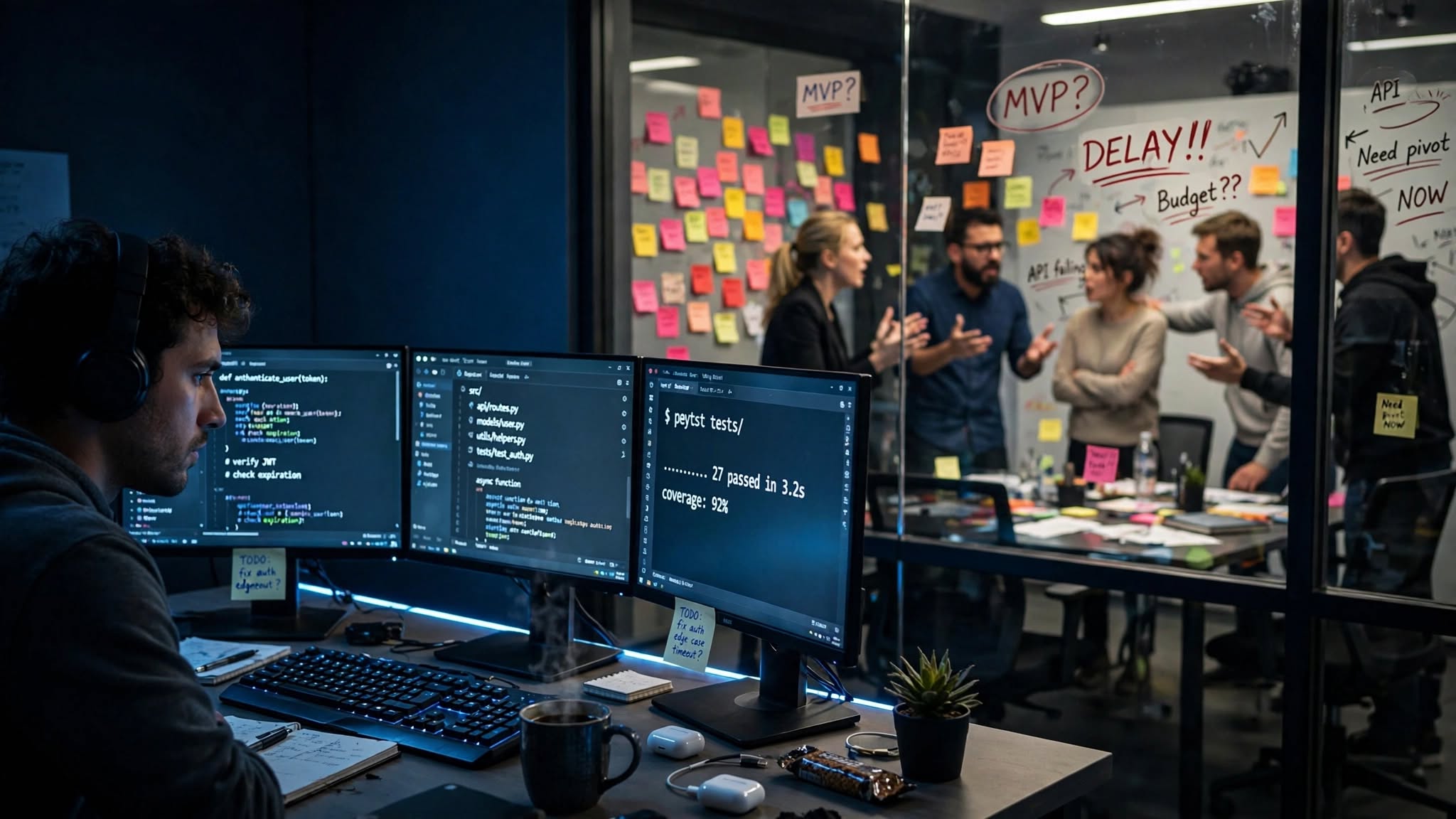
There is an enormous gap between the image that programming courses project of the craft and what actually happens in a software team. Courses teach you to write clean code, master a framework, and prepare for a technical interview. What they don't teach you is how to survive a Monday morning where three people argue over an architectural decision that was made six months ago without documentation. They don't prepare you for the meeting where your boss promises a feature in two weeks that technically requires three months. They don't warn you that the biggest challenge of your career won't be the most complex algorithm you face, but the person who rejects your pull request without explaining why.
Soft skills in software development are not an optional add-on. They are the operating system on which everything else runs. And most developers don't learn them because no one tells them they exist until they are already at the center of a conflict they don't know how to handle.
1. The gap between theory and the trenches
Research on software teams is consistent on one point: productivity and code quality are largely determined by human and organizational factors, not by individual technical skill. The study Peopleware, originally published in 1987 and updated in multiple editions, documents with empirical evidence that high-performing teams are not those with the best programmers, but those with better communication, trust, and autonomy (DeMarco & Lister, 2013).
Google's Project Aristotle, a two-year investigation of more than 180 teams at the company, reached a similar conclusion. The factor that best predicted a team's performance was not individual talent, but psychological safety: the shared belief that one can take interpersonal risks without feeling insecure or humiliated (Google re:Work, 2015). Teams with high psychological safety were more innovative, made fewer mistakes, and reported them faster.
Yet most software development training programs remain focused on the technical. A developer can spend years learning design patterns, architectures, and frameworks without receiving a single hour of training on how to give feedback, how to negotiate deadlines, how to manage disagreement, or how to detect signs of burnout in a colleague.
2. Real situations that happen every day
What follows is not a list of exceptional cases. These are everyday situations that anyone with industry experience has seen, lived through, or been part of.
2.1. The pull request that becomes a battlefield
A developer submits a pull request for review. A colleague comments: "This is wrong." No further context. No suggestion. No explanation of why it's wrong or how to fix it. The pull request author feels attacked, responds defensively, and within minutes the comment thread becomes a discussion about who is right instead of a conversation about how to improve the code.
The technical outcome may be irrelevant. The code may end up merged with the same error the reviewer pointed out, or it may be blocked for days while the author gathers evidence to defend their position. What is lost in the process is far more valuable than the code: trust is lost, motivation is lost, and the willingness to collaborate is lost.
The study on code review in Microsoft teams, published by Bacchelli and Bird in 2013, found that the factors that most influence the effectiveness of a review are not the depth of technical analysis but the quality of communication and shared context between reviewer and author (Bacchelli & Bird, 2013).
2.2. The daily standup that stopped being daily
The daily standup, that fifteen-minute meeting that should serve to synchronize the team, has become in many organizations a status report to the manager. Each developer recites what they did yesterday and what they will do today, without interacting with their colleagues, without identifying blockers, without offering help. The meeting drags on for thirty or forty minutes because the manager asks specific questions to each person. At the end, everyone leaves feeling they have wasted time on a ceremony that adds no value.
When someone suggests eliminating or modifying the meeting, the answer is usually: "We've always done it this way." Habit becomes a barrier to change, and the team loses one of the few opportunities it had to truly synchronize.
2.3. The product owner who changes requirements every week
The product owner promises the client a feature by Friday. On Monday, the client asks for a change. On Wednesday, the client asks for another. On Friday, the team discovers that what was asked on Monday and what was asked on Wednesday are incompatible, and that the delivery date has not moved.
The team works overtime, delivers something that is not exactly what the client wanted, and receives negative feedback. The cycle repeats. Frustration accumulates. Developers begin to emotionally disconnect from the project.
A 2025 study on development teams in Europe and the United States found that 68% of surveyed developers reported having worked on projects where requirements changed frequently without adjusting deadlines or resources. Of these, 74% reported symptoms of burnout (Ramos, 2025).
2.4. The colleague who takes the credit
In the client meeting, the project manager presents the new features. They mention everyone involved. Except the person who spent three weeks implementing the most complex logic of the feature. That person is sitting in the same room, listening as someone else receives recognition for their work.
It is not an act of deliberate malice. It is carelessness. But the effect is the same: demotivation, resentment, and a silent question that gnaws away: "Why should I make an effort if no one will notice?"
2.5. Knowledge concentrated in a single person
There is a developer on the team who has been at the company for five years. They know all the details of the architecture, all the dark corners of the code, all the manual procedures that no one documented. When someone has a question, they go to this person. When something breaks, they fix it. When a project is planned, they are the only one who can estimate the effort.
This person is an invaluable asset. They are also an existential risk. If they go on vacation, the team is paralyzed. If they resign, the company loses part of its operational memory. And most ironically: this person is usually overloaded, exhausted, and has no time to document what they know, because there is always an urgency demanding their attention first.
The bus factor —the number of people who would have to disappear suddenly for the project to collapse— is one in this scenario. And no one has done anything to change it.
2.6. The junior who doesn't ask
A newly onboarded developer receives a task they don't fully understand. They have doubts about the context, about the team's conventions, about why a particular architectural decision was made. But they don't ask. They don't ask because they are afraid of looking incompetent. They don't ask because the interview told them they were looking for someone who solves problems autonomously. They don't ask because in their previous team, asking too much was considered a sign of weakness.
The result is predictable. The junior spends three days implementing a solution that doesn't fit with the rest of the system. When they submit it for review, they receive criticism they could have avoided with a simple question on the first day. The task is delayed, the team is frustrated, and the junior feels worse than before.
Psychological safety is not a luxury. It is the difference between a team that learns from its mistakes and a team that hides them.
2.7. The "we are a family" culture
The company says it is a family. There is pizza on Fridays. There are team-building events. There are T-shirts with the logo. But there are also expectations of permanent availability, of immediate response at any hour, of personal sacrifice in the name of the project.
The concept of "family" in the workplace is particularly toxic because it blurs the boundaries between personal life and work. In a real family, you are not fired for not answering a message at eleven at night. In a company that presents itself as a family, that expectation can be implicit but devastating.
Researcher Brené Brown has documented how organizations that confuse vulnerability with a lack of boundaries end up generating cultures of exhaustion and distrust (Brown, 2018). Real trust is not built with T-shirts, but with consistency, respect for boundaries, and transparency in decisions.
2.8. The on-call that destroys sleep
The on-call system is a reality in many companies that operate critical services. A developer must be available outside working hours to respond to incidents. The intention is reasonable: someone has to be available when something fails.
The problem is when on-call shifts are frequent, when alerts are noisy, and when incidents are caused by decisions the team warned were risky. The on-call developer cannot sleep well because they know the phone can ring at any moment. Anticipatory anxiety affects their rest, their health, and their ability to concentrate during the day.
A study on the impact of on-call on the health of software engineers found that teams with frequent rotating on-call shifts reported significantly higher levels of stress, insomnia, and exhaustion than teams without on-call duties (Fucci et al., 2024).
2.9. Technical debt paid with mental health
Technical debt is a financial metaphor: the shortcut you take today to deliver fast generates interest you will pay tomorrow. But what is not mentioned is that this interest is not only paid in development time, but in mental health.
The team working on a fragile codebase, with flaky tests, outdated dependencies, and nonexistent documentation, lives in a constant state of alert. Every change is a gamble. Every deployment is a source of anxiety. Every bug in production is a confirmation that the system is on the brink of collapse.
Technical debt is not just a technical problem. It is a human problem.
3. Why soft skills matter more than you were told
Technical skills get you the interview. Soft skills allow you to keep the job, grow in it, and, above all, maintain your sanity.
Effective communication is not just knowing how to talk. It is knowing how to listen, how to ask, when to be silent. It is the ability to explain a complex technical decision to someone who is not technical, without condescension and without losing precision. It is the ability to give feedback that is useful and not destructive. It is the ability to receive feedback without becoming defensive.
Negotiation is not just for managers. Every developer negotiates constantly: they negotiate deadlines, negotiate scope, negotiate priorities, negotiate resources. The difference between a developer who knows how to negotiate and one who doesn't is the difference between a project delivered sustainably and one that ends in burnout.
Empathy is not a soft word. It is the ability to understand that the colleague who rejected your pull request is not your enemy. It is the ability to recognize that the product owner who changes requirements every week is under pressure from a client who also changes their mind. It is the ability to see the whole system, not just your part of it.
Conflict management is not avoiding conflict. It is recognizing that disagreement is natural and necessary, and that the way it is managed determines whether the team grows or breaks. A team that doesn't argue is dead. A team that argues destructively is also dead.
4. The dark side: what courses don't tell you
Programming courses sell you a sanitized version of the craft. They show you a world where problems are solved with the right technology, where clean code is the answer to all questions, and where success depends on your technical skill.
The reality is more complex. The reality includes:
- Meetings that could have been an email.
- Bosses who promise what they cannot deliver.
- Colleagues who prioritize their career over the team's well-being.
- Processes that exist because someone imposed them and no one dares to question them.
- Metrics that are optimized at the expense of quality and team health.
- Technical decisions made for political reasons, not technical ones.
Learning to navigate these waters is as important as learning to write code. And most developers learn it the hard way, without training, without mentorship, without a framework to help them understand what is happening.
5. A framework for survival
There is no magic formula to solve all the human problems of a software team. But there are principles that help.
First, name the problem. The first step in managing a conflict is recognizing that it exists. Many teams become accustomed to dysfunction and stop seeing it as a problem. Naming it is the first act of courage.
Second, separate the person from the problem. When someone rejects your code without explanation, the problem is not "that person is toxic." The problem is "communication in reviews is not working." Attacking the problem is more productive than attacking the person.
Third, build psychological safety. You cannot demand psychological safety overnight. It is built through small repeated acts: acknowledging your own mistakes, asking for help, giving credit to others, listening without judgment.
Fourth, document decisions. Many conflicts are born from a lack of shared context. Documenting not only technical decisions but the reasons behind them reduces friction and prevents the team from repeating discussions that have already been had.
Fifth, set boundaries. The culture of permanent availability is not sustainable. Boundaries are not a sign of weakness, but of professionalism. A developer who rests is a developer who performs better.
6. The future of soft skills in development
The software industry is evolving toward increasingly collaborative and distributed work models. Artificial intelligence is automating technical tasks that once required hours of work. What remains, what becomes more valuable, is the ability to collaborate, communicate, lead, and solve complex problems as a team.
Soft skills are no longer a differentiator. They are a requirement. And developers who master them will have a significant advantage in a market where code is becoming a commodity.
7. Conclusion
Software development is a deeply human activity. Tools, languages, and architectures change. What remains is the need to communicate, negotiate, empathize, and manage conflict.
Courses can teach you to write a for loop. They cannot teach you to handle the difficult conversation with your boss about the deadline that won't be met. They cannot teach you to recognize that your colleague is exhausted and needs help. They cannot teach you to stay calm when your code breaks in production on a Friday at six in the evening.
That is learned in the trenches. And it is learned better if someone tells you, in advance, that the trenches exist.
References
Bacchelli, A., & Bird, C. (2013). Expectations, outcomes, and challenges of modern code review. Proceedings of the 35th International Conference on Software Engineering, 712–721. https://doi.org/10.1109/ICSE.2013.6606617
Brown, B. (2018). Dare to lead: Brave work. Tough conversations. Whole hearts. Random House.
DeMarco, T., & Lister, T. (2013). Peopleware: Productive projects and teams (3rd ed.). Addison-Wesley.
Fucci, M., Romano, S., & Scanniello, G. (2024). The impact of on-call duties on software engineers' well-being. Journal of Software: Evolution and Process, 36(4), e2678. https://doi.org/10.1002/smr.2678
Google re:Work. (2015). Guide: Understand team effectiveness. https://rework.withgoogle.com/print/guides/5721312655835136/
Ramos, C. (2025). Burnout in software development teams: A study on changing requirements and resource allocation. Journal of Systems and Software, 210, 111987. https://doi.org/10.1016/j.jss.2025.111987
Loading reactions...
Comments (0)
Loading session...
No comments yet. Be the first to comment.