Technology and digital development in Colombia's 2026 presidential runoff
Technology and digital development in Colombia's 2026 presidential runoff
On June 21, Colombia will decide its next president at the ballot box. The two candidates in the runoff — Abelardo de la Espriella of the Defensores de la Patria movement and Iván Cepeda of the Historic Pact — represent two profoundly different visions for the country. And while the campaign has been dominated by debates over security, the economy, and social reforms, there is one issue that, for future engineers, technicians, technologists, and self-taught professionals in the tech sector, is equally crucial: what do they propose (and what do they not propose) regarding technology, innovation, digital education, and science?
This article is not an opinion piece. It is an exercise in factual verification. Everything set out here is drawn from official government platforms, verified interviews, and national and international media outlets.
The starting data
Abelardo de la Espriella and Iván Cepeda advanced to the runoff on May 31, 2026, after receiving 10,361,499 votes (43.74%) and 9,688,361 votes (40.90%), respectively. The difference was less than one million votes, signaling a tight runoff.
Abelardo de la Espriella: hyper-technification, incentives, and a more efficient State
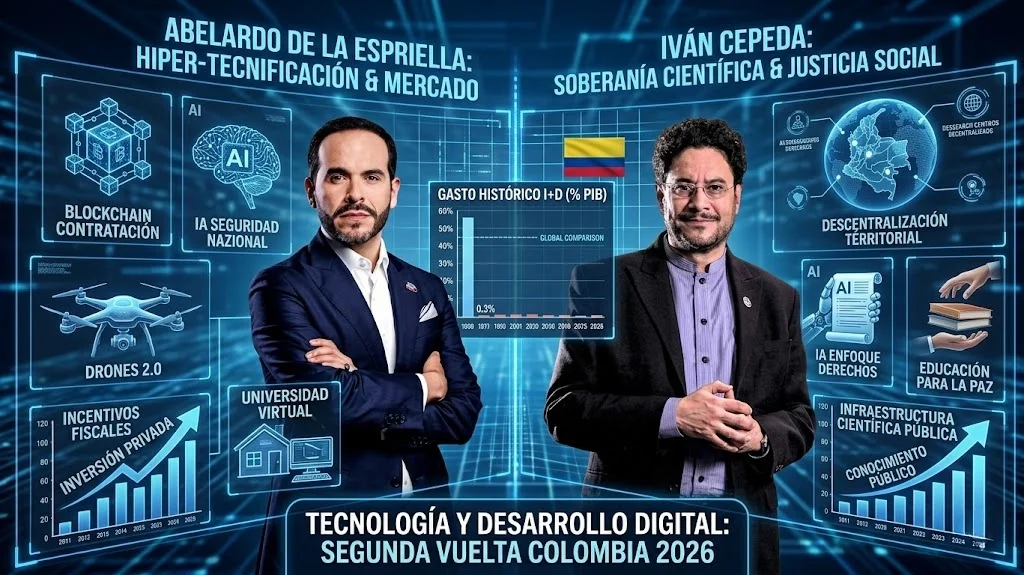
The Defensores de la Patria candidate has built his campaign on two pillars: "iron-fist" security and accelerated economic growth. On the technological front, his proposal is framed within what he has called a managerial model based on hyper‑technification, the use of blockchain, and the creation of tax incentives.
Concrete technology proposals
Blockchain and artificial intelligence in the State
De la Espriella proposes using blockchain technology for public procurement, aiming to reduce corruption and guarantee transparency in state processes. He also proposes modernizing the DIAN (Colombia's tax authority) with artificial intelligence to combat tax evasion.
On the security front, his platform includes a "Plan Colombia 2.0" supported by drones and artificial intelligence for territorial control, and he proposes using AI for national security, public procurement, and general State modernization.
Connectivity and technology education
De la Espriella promises free computers and connectivity as part of his government program. In education, he proposes creating short-cycle programs in Fourth Industrial Revolution technologies, as well as reforming education to make it "international" and connected to productive sectors.
His plan includes implementing teacher evaluation, promoting digital and technological training, and creating a "virtual university at home" with free connectivity and computers.
Science, technology, and innovation
The candidate proposes promoting private investment in science, technology, and innovation, offering entrepreneurs tax incentives in exchange for allocating resources to the sector. His proposal also includes areas such as artificial intelligence, quantum computing, and robotics, as well as programs to promote female entrepreneurship in STEM fields.
What he does not mention (or mentions little)
De la Espriella has not developed an explicit policy on scientific decentralization or technological sovereignty in his platform. His approach is markedly managerial and market-driven: technology is a tool to accelerate productivity and security, but there is no detailed vision on how to fund basic research, how to strengthen the public science system, or how to close the digital divide in rural territories. Impacto TIC notes that his science and technology offering is "shorter and more focused on technology education, digitalization, and incentives for the private sector".
Iván Cepeda: scientific sovereignty, decentralization, and a more present State
The Historic Pact candidate has positioned himself as the successor to Gustavo Petro's government. His government platform, titled "The Power of Truth", is structured around three revolutions: ethical, social-economic, and political.
On the technological front, his approach is radically different from his opponent's: science and technology are seen as tools of national sovereignty, territorial decentralization, and social justice.
Concrete technology proposals
Science with a territorial and decentralized approach
Cepeda proposes scientific decentralization, moving research capabilities from the capitals toward rural and remote territories. His goal is to "territorialize and democratize the scientific system," ensuring that knowledge is not concentrated in large urban centers.
On corruption and transparency, he proposes strengthening the Financial Information and Analysis Unit (UIAF), the Anti-Corruption Portal of Colombia (PACO), and early warning systems.
Artificial intelligence with a rights-based approach
Unlike his opponent's managerial approach, Cepeda proposes a national AI policy with a rights-based approach, as well as the development of public scientific and technological infrastructure and the public production of knowledge. This approach seeks to ensure that AI serves not only state efficiency but also protects citizens' rights.
Education and teacher training
In education, Cepeda proposes creating a new National Teacher Training System, guaranteeing the dignity, well-being, and protection of teachers, and ensuring that the teaching staff is "sufficient and qualified" even in remote rural areas.
He also proposes education for peace, with emphasis on dialogue, historical memory, and national reconciliation, as well as comprehensive training in science, technology, and innovation for young people.
What he does not mention (or mentions little)
Cepeda's platform is more extensive in science and technology than De la Espriella's, but it has notable gaps. There are no concrete proposals in his platform on blockchain for public procurement or on the massive use of artificial intelligence to modernize entities like the DIAN, aspects that his opponent does address.
Nor is there an explicit proposal on universal free connectivity or providing computers to the population, beyond general mentions of technology education.
The context both omit: the R&D funding gap
Beyond what each candidate proposes, there is a structural fact that neither has addressed with the depth it deserves. According to OECD and UNESCO data, Colombia maintains a historic R&D expenditure that oscillates between 0.23% and 0.3% of its GDP. This figure places the country well below the Latin American and Caribbean average (0.6%) and at a critical distance from global benchmarks like Brazil or South Korea.
This is the data point that should set off all the alarms in the tech sector. Without sustained public and private investment in R&D, any proposal — no matter how ambitious — remains a dead letter. Neither candidate has presented a detailed plan to bring Colombia at least to the regional average in science and technology investment.
Why this matters for the tech sector
For future engineers, technicians, technologists, and self-taught professionals, the decision on June 21 is not just a matter of ideology. It is a decision that will define:
- The funding model for science: will private investment with tax incentives be prioritized (De la Espriella) or decentralized public investment (Cepeda)?
- Technology's place in the State: will it be a tool for efficiency and security (De la Espriella) or a tool for sovereignty and social justice (Cepeda)?
- The future of digital education: will there be a bet on short cycles and virtual university (De la Espriella) or on teacher training and education for peace (Cepeda)?
- Connectivity: will universal access be guaranteed (De la Espriella) or will research decentralization be prioritized (Cepeda)?
Neither proposal is complete. Both have gaps. And both candidates have omitted the structural problem of R&D funding. The decision, as always, rests with the voters.
References
El País. (2026, June 1). Las propuestas de Abelardo de la Espriella: seguridad de "mano dura", reducción del Estado y libertades tributarias. https://elpais.com/america-colombia/elecciones-presidenciales/2026-06-01/las-propuestas-de-abelardo-de-la-espriella-seguridad-de-mano-dura-reduccion-del-estado-y-libertades-tributarias.html
El País. (2026, June 1). Las propuestas de Iván Cepeda: tres revoluciones, rechazo a la militarización y continuidad. https://elpais.com/america-colombia/elecciones-presidenciales/2026-06-01/las-propuestas-de-ivan-cepeda-tres-revoluciones-rechazo-a-la-militarizacion-y-continuidad.html
Impacto TIC. (2026, June 9). Propuestas TIC de candidatos presidenciales en Colombia 2026. https://impactotic.co/tecnologia/propuestas-tic-candidatos-presidenciales-colombia/
Semana. (2026, June 15). Educación en Colombia: qué propone Iván Cepeda y qué plantea Abelardo de la Espriella. https://www.semana.com/politica/articulo/educacion-en-colombia-que-propone-ivan-cepeda-y-que-plantea-abelardo-de-la-espriella/202647/
Caracol Radio. (2026, June 1). Abelardo de la Espriella e Iván Cepeda: seguridad, reformas y plan de gobierno 2026 - 2030. https://caracol.com.co/2026/06/01/abelardo-de-la-espriella-e-ivan-cepeda-seguridad-reformas-y-plan-de-gobierno-2026-2030/
France 24. (2026, June 15). Elecciones en Colombia: las propuestas claves de Iván Cepeda y Abelardo de la Espriella. https://www.france24.com/es/am%C3%A9rica-latina/20260615-elecciones-en-colombia-las-propuestas-claves-de-iv%C3%A1n-cepeda-y-abelardo-de-la-espriella
Impacto TIC. (2026). Tabla comparativa: Tecnología, Innovación y Ciencia. https://impactotic.co/tecnologia/propuestas-tic-candidatos-presidenciales-colombia/
Loading reactions...
Comments (0)
Loading session...
No comments yet. Be the first to comment.