The relational database market in the first half of 2026: from the wounded giant to the new star
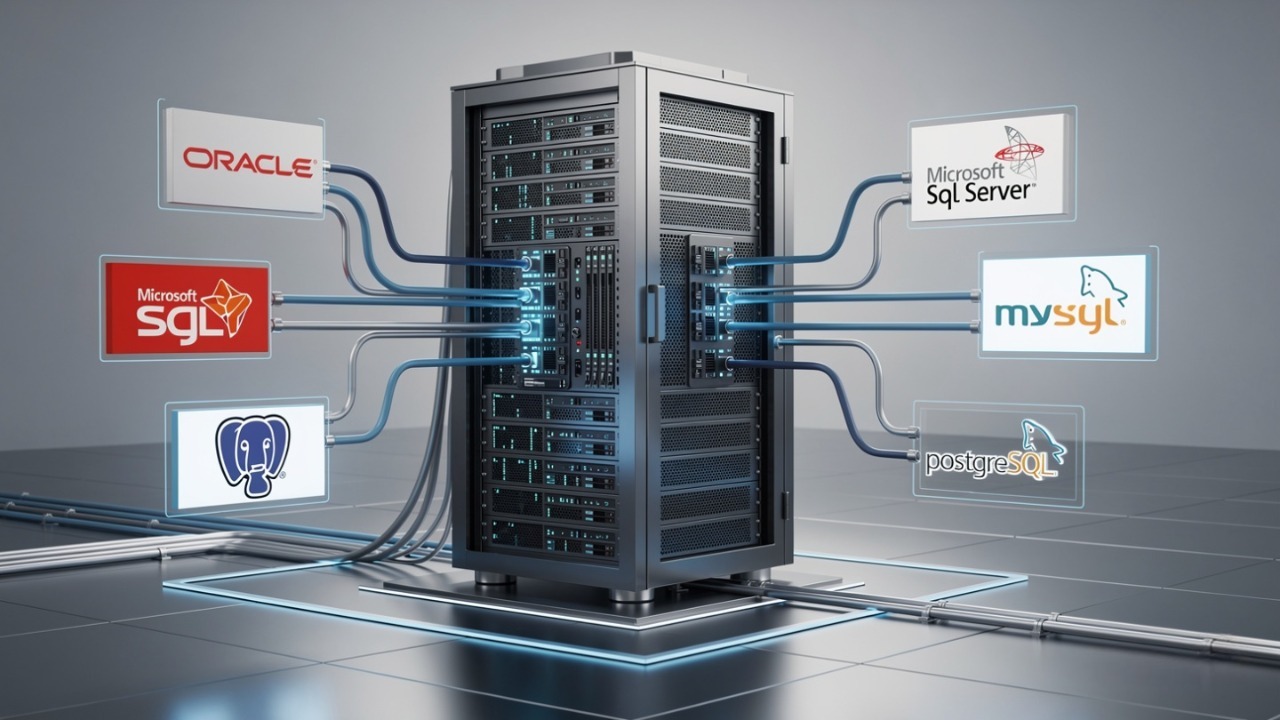
A fact few people mention: the relational segment still dominates the database management systems market with 61.8%, far ahead of NoSQL, NewSQL, and other alternatives. And it is not a static dominance. Between 2025 and 2026 the market grew from 82.95 billion to 93.06 billion dollars, a compound annual growth rate of 12.2%.
But the winds are not blowing equally for everyone. What makes the first half of 2026 so interesting is that it combines two opposite phenomena. On one hand, absolute stability in the top spots of general popularity: Oracle, MySQL, SQL Server and PostgreSQL remain firm month after month in global rankings like DB-Engines. On the other hand, deep turmoil in developer preferences. PostgreSQL has established itself as the new favorite among those starting new projects, while MySQL faces the most critical moment in its history, with urgent calls for Oracle to transfer its governance to an independent foundation. At the same time, cloud platforms are redefining what it means to "use" a database.
This article analyzes the five most important relational engines of the moment, from the one that closes the Top 5 of real usage (according to 6sense data on active companies) to the undisputed popularity leader. The order is not the ranking score order, but real usage in companies during this first half of 2026. At the end you will find a poll to share your experience and see the preferences of the CodeWithBotina community.
5. MariaDB – The engine growing in the shadows
MariaDB is the result of a fork. When Oracle acquired Sun Microsystems in 2010, Michael "Monty" Widenius, the original creator of MySQL, feared for the open future of his creation. He took the code from the last completely free version and founded MariaDB. Fifteen years later, the project is not only still alive, but its corporate usage share is very close to PostgreSQL according to OpenLogic market measurements.
MariaDB's strength lies where MySQL is beginning to falter: in its community governance and not depending on a large corporation. Unlike MySQL, whose fate is in Oracle's hands, MariaDB is managed by the MariaDB Foundation. This structure has allowed it to maintain a steady pace of innovation and attract organizations that value vendor independence.
However, MariaDB lives in a niche. It is the alternative for those who want MySQL compatibility but without its governance model. It has not managed to become the de facto standard that MySQL once was, but its adoption is solid and stable.
4. Microsoft SQL Server – The corporate pillar
Microsoft SQL Server remains the third most popular database in the world according to DB-Engines, behind only Oracle and MySQL. Its strength has historically been in corporate environments deeply integrated with the Microsoft ecosystem. But 2026 brings changes.
The cloud database market is led by AWS, Microsoft and Google Cloud Platform in that order of revenue. Azure SQL Database and managed instances of SQL Server have allowed Microsoft to retain its traditional customer base while slowly migrating them to the cloud. However, competitive pressure is enormous. AWS has built a managed database ecosystem that directly rivals SQL Server, and PostgreSQL has become the preferred open source alternative even within Azure.
An interesting phenomenon documented by multiple migration analyses is the push toward technological independence, especially in regulated sectors such as finance and public administrations. Many organizations are actively evaluating alternatives to SQL Server, not for technical reasons, but for strategic reasons of autonomy and long term costs.
SQL Server is not going away. Its installed base is massive and its integration with the rest of Microsoft's tools remains a differential advantage. But its growth has slowed in the face of the open source tide.
3. Oracle Database – The undisputed king (for now)
Oracle remains the most popular database in the world. DB-Engines confirms it month after month. In the May 2026 ranking, Oracle tops the list with a score more than double that of MySQL. In general popularity metrics, Oracle has a 35.32% share, more than three times that of MySQL and almost four times that of PostgreSQL.
Oracle's strength lies in large corporations. Banks, insurance companies, telecom operators and public administrations have built their critical systems on Oracle for decades. Migrating out of that ecosystem is not only technically complex, but economically prohibitive in many cases.
But Oracle is not sleeping. Its multicloud database business grew 531% year over year in the third fiscal quarter of 2026. It has signed strategic alliances with AWS and Azure, allowing Oracle Database to run directly on its competitors' clouds. The strategy is smart: instead of fighting the cloud, it rides on top of it.
Oracle's real challenge is not technical, but generational. Younger developers did not grow up with Oracle. They learn with PostgreSQL, build prototypes with MySQL, and deploy on cloud native databases. Oracle remains the king of existing systems, but the battle for new projects is being fought on a different field.
2. MySQL – The wounded giant
This is the most complex case in the ranking. Because if we look only at the aggregate figures, MySQL is still a titan. 6sense reports that more than 155,000 companies actively use MySQL, representing a 39.1% market share among all relational databases. It is, by far, the most widely used relational engine in the world in terms of number of companies.
However, the reality beneath those figures is worrying. An open letter signed by prominent members of the MySQL community, published in February 2026, warns that the project is at real risk of becoming irrelevant. The complaint is concrete: since MySQL 8.0 released in 2018, there have been barely any significant advances. Oracle moved MySQL to its OCI infrastructure and cut the team in half, losing key competence in the process.
The result is an accelerated loss of popularity. In Stack Overflow 2025, 55.6% of developers used PostgreSQL, while MySQL fell to 40.5%. Among "most admired technologies", PostgreSQL is at 46.5% and MySQL languishes at 20.5%. New projects and young developers no longer choose MySQL by default. They choose PostgreSQL.
The community has responded strongly. In February 2026, a group of community leaders published an open letter asking Oracle to transfer MySQL to an independent foundation, similar to the model of the Apache Software Foundation or the Linux Foundation. The petition has generated intense debate and, for now, Oracle has not responded with a concrete proposal.
MySQL remains an excellent database for many use cases. Its simplicity, proven stability and huge installed base ensure it will not disappear soon. But the first half of 2026 is probably the most uncertain moment in its history.
1. PostgreSQL – The new star
PostgreSQL is the phenomenon of the moment. Not only in terms of growth, but in the general sentiment of the community. In 2025, 55.6% of developers surveyed by Stack Overflow reported using PostgreSQL, the highest figure for any database. And growth does not stop.
The reason for this success is multiple. PostgreSQL combines an extremely active community with a transparent governance model. Its foundation oversees development without depending on a single corporation, ensuring the project's independence. Additionally, PostgreSQL has innovated in critical areas: native support for JSON data, extensions like PostGIS for geospatial data, and more recently pgvector for similarity search in AI embeddings. The major hyperscalers have bet heavily on PostgreSQL. AWS, Azure and Google Cloud Platform offer managed versions of the engine and are investing in its ecosystem.
The most revealing data point of the first half of 2026 is the growth of the ecosystem. GitHub projects related to PostgreSQL have grown 300% in the last three years. 65% of PostgreSQL instances managed by a major cloud provider are used to support artificial intelligence applications, a much higher proportion than any other database.
PostgreSQL is not perfect. Its MVCC (Multiversion Concurrency Control) concurrency model can be complex to manage at massive scales, and dead tuple cleaning (VACUUM) requires attention. But the community responds: recent versions have dramatically improved parallel query performance and logical replication, directly addressing these weak points.
Stack Overflow 2025: the survey that confirms the shift
The annual Stack Overflow survey for 2025, published in early 2026, is perhaps the most reliable thermometer of what developers actually use day to day. The numbers are clear. PostgreSQL leads with 55.6% usage, followed by MySQL with 40.5%, SQLite with 30.9%, MongoDB (NoSQL) with 28.6%, and Microsoft SQL Server with 26.3%.
The gap between PostgreSQL and MySQL is not a mirage of a specific month. In the 2023 survey, PostgreSQL surpassed MySQL for the first time. In 2024 it consolidated the lead. 2025 widened the difference. The trend is unequivocal and will likely hold in the 2026 survey to be published in the coming months.
When asked about the most admired technologies, PostgreSQL scores 46.5%, while MySQL stays at 20.5%. This is not a minor data point. Admiration translates into advocacy for the technology, recommendations, and adoption decisions for new projects. Developers do not just use PostgreSQL, they believe in it.
The forces moving the market
Beyond each specific engine, 2026 is witnessing structural changes in how databases are consumed. The cloud has forever altered the balance. AWS, Microsoft, Oracle and Google Cloud Platform are the big four in revenue, and all offer their own managed versions of the most popular open source engines. For the developer, the difference between using PostgreSQL directly or through Amazon RDS is increasingly small.
Artificial intelligence is redrawing requirements. More than 75% of new applications will incorporate built-in AI capabilities, according to analyst projections. Databases need to handle vector embeddings, similarity search and mixed workloads. PostgreSQL with pgvector is well positioned. MySQL and SQL Server are catching up.
Finally, governance matters more than ever. Young developers do not want to depend on what a large corporation decides for their favorite database. That is why the MySQL community is asking for an independent foundation, and why PostgreSQL is reaping so much support. In 2026, vendor independence is a market value.
Your turn: which relational engine are you using in 2026?
Statistics are one thing. The reality of each team, each project and each technology stack is another. I want to know which relational engine you are using in this first half of 2026 and, above all, why you chose it.
It is time to participate in the poll.
References
6sense. (2026). Best Relational Databases Software in 2026. 6sense Market Intelligence.
DB-Engines. (2026). DB-Engines Ranking of Database Management Systems. Monthly ranking, May 2026.
EDB. (2026). The Postgres Vitality Index: Enterprises Rush to Postgres, and EDB Continues to Lead the Foundation for Sovereign Enterprise AI. EnterpriseDB.
GII Research. (2026). Relational Database Global Market Report 2026. Global Industry Analysts.
OpenLogic. (2026). Top Open Source Databases and Data Technologies in 2026. Perforce OpenLogic.
Percona. (2026). An Open Letter to Oracle: Let's Talk About MySQL's Future. Percona.
PYPL. (2026). TOPDB Top Database Index. PopularitY of Programming Language.
Redgate. (2026). What are the top database platforms in 2026? A look at the latest data. Redgate Software.
SD Times. (2026). MySQL community calls for Oracle to establish a foundation to ensure project's future. SD Times.
Stack Overflow. (2025). Stack Overflow Developer Survey 2025. Stack Overflow.
Wikipedia. (2026). MariaDB. Wikimedia Foundation.
Loading reactions...
Comments (0)
Loading session...
No comments yet. Be the first to comment.