The variable: the fundamental unit of memory
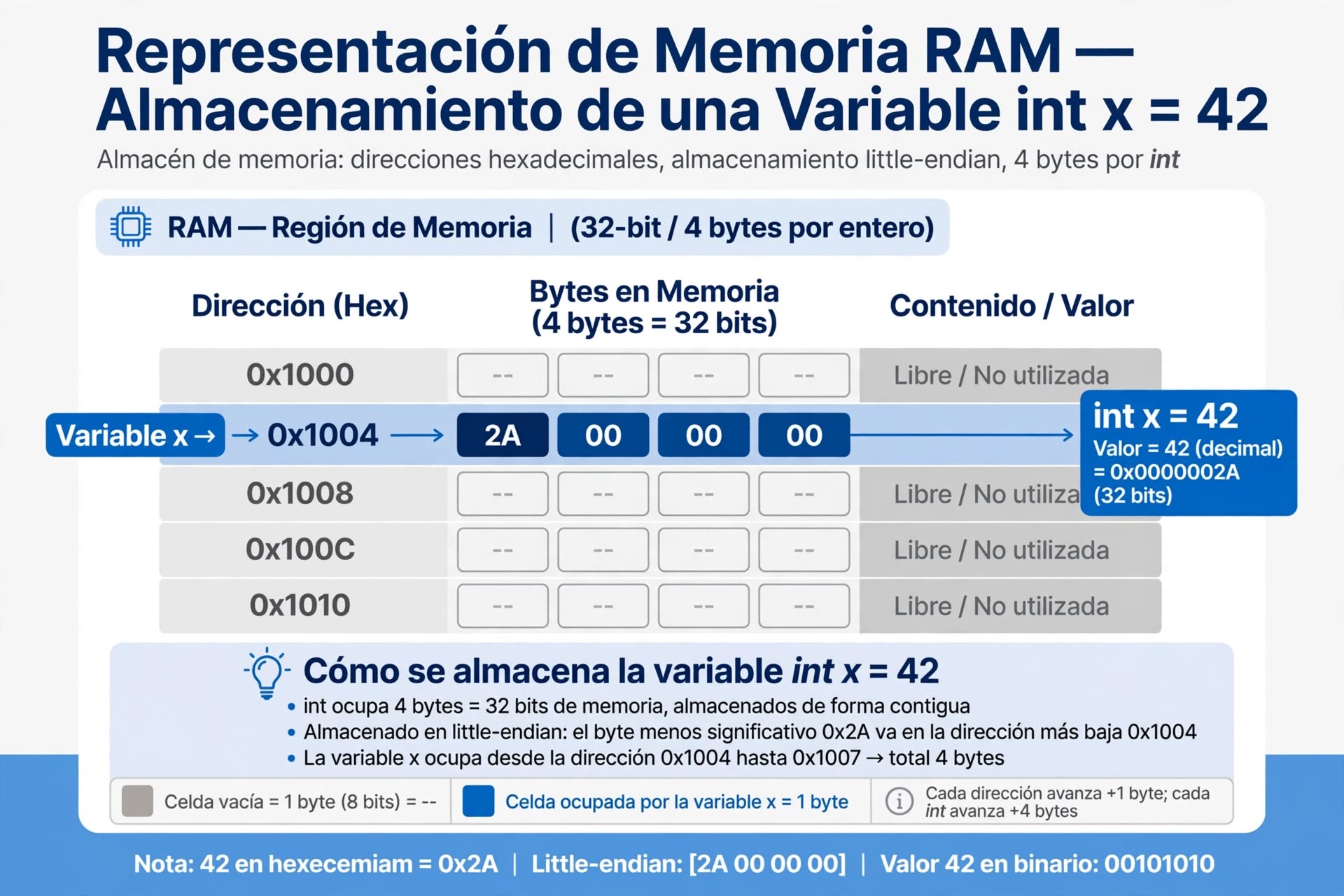
In software development, everything reduces to a single elementary operation: storing a value somewhere and retrieving it later. That is the essence of programming. A variable is the name we give to that place. But behind that name lies an entire universe of design decisions, memory organization, and hardware behavior that determines how our program behaves.
This article is the first in a series where we will break down the basic concepts of programming until they are reduced to their purest form: what actually happens in the machine when we write a line of code.
What is a variable?
A variable is a storage space in the computer's memory that is assigned a symbolic name. When we declare a variable, we are asking the operating system to reserve a block of bytes in RAM to contain a piece of data. That block has a unique address, and we, as programmers, refer to it by the name we have chosen.
In terms closer to the hardware, a variable consists of three fundamental elements:
- A memory address
- A size (in bytes)
- A value (the sequence of bits stored in that space)
The name of the variable is merely an abstraction for humans. The compiler or interpreter translates that name into the corresponding memory address. Without this translation, we would be programming by writing numeric addresses, as was done in the early days of computing.
RAM and storage cells
To understand what a variable is, we must understand the medium where it lives: RAM. RAM is a set of cells, each capable of storing one byte (8 bits). Each cell has a unique address that allows the processor to read from or write to it.
flowchart LR
    subgraph RAM_Memory["RAM Memory"]
        direction LR
        D0["Address 0x0000: 00101101"]
        D1["Address 0x0001: 01011010"]
        D2["Address 0x0002: 11110000"]
        D3["..."]
        D4["Address 0xFFFF: 00000000"]
    end
When we declare a variable, the system reserves a certain number of these cells. For example, a variable of type int in C typically occupies 4 bytes (32 bits), so it reserves 4 consecutive cells. The address of the first cell becomes the variable's address.
How a variable looks in memory
Let us take a concrete example. In the C language:
int age = 25;
The compiler translates this line into:
- Reserve 4 bytes on the stack (or in the data section, depending on the context)
- Store the value 25 in those 4 bytes in binary format
- Associate the name "age" with the starting address of those 4 bytes
In memory, this looks like this:
flowchart LR
    subgraph Memory["Memory"]
        D0["Address 0x7FFE1234 (age): 00 00 00 19"]
    end
    subgraph Explanation["Explanation"]
        T["0x19 = 25 in decimal"]
        S["4 bytes: 0x00 0x00 0x00 0x19"]
    end
The value 25 in binary (00011001) is stored in the 4 bytes, typically in little-endian order on most modern systems.
What makes a variable special?
At first glance, a variable seems trivial: a name and a value. But its true importance lies in the fact that it is the bridge between the abstract world of algorithms and the physical world of the machine. Let us look at its most relevant aspects.
Mutability
A variable can change its value over time. This ability to modify state is what allows a program to have dynamic behavior. Without mutability, we could only work with constants and could not implement loops, counters, or any logic that depends on changing conditions.
In modern languages, mutability can be deliberately restricted (for example, with const in JavaScript, final in Java, or let/var in Rust) to prevent errors and make code more predictable.
Scope
A variable's scope determines in which parts of the program it is visible and accessible. Variables can be global (accessible from anywhere), local (accessible only within a function or block), or instance variables (belonging to an object). Scope is resolved at compile time or runtime depending on the language.
In languages like C or Java, scope is determined by the braces that enclose the code. In other languages like Python, scope is defined by indentation and function structure.
Type
A variable's type defines what kind of data it can store and what operations can be performed on it. Types can be primitive (integers, floats, characters, booleans) or composite (arrays, structures, objects). The type determines the size of the reserved memory and the interpretation of the stored bits.
In statically typed languages (C, Java, Rust), the type is known at compile time, enabling optimizations and early error detection. In dynamically typed languages (Python, JavaScript), the type is determined at runtime, offering greater flexibility at the cost of performance.
Lifetime
A variable's lifetime is the period during which it exists in memory. It can be:
- Static: exists throughout the entire program execution (global or static variables)
- Automatic: created upon entering a block and destroyed upon exiting (local variables on the stack)
- Dynamic: explicitly created and destroyed through allocation function calls (heap memory)
Each strategy has performance and memory management implications.
How variables are implemented in different languages
In C: the hardware language
C is the language closest to the metal. A variable in C is declared with a type and a name, and the compiler allocates space on the stack or in the data section depending on the context. There is no hidden overhead; the variable is exactly the bytes it occupies.
int x = 10;    // 4 bytes on the stack
static int y;  // 4 bytes in the data section
The compiler can optimize by eliminating unused variables or reusing CPU registers, but conceptually, each variable is a memory location.
In Python: the variable as a reference
In Python, variables are references to objects on the heap. When we assign a value, we are actually creating an object and making the variable point to it.
a = 10 # Creates an int object with value 10, and a points to it
The variable itself is just an entry in a symbol table containing the reference to the object. This allows variables to be dynamic and have no fixed type.
In JavaScript: the global object
JavaScript follows a model similar to Python but with the peculiarity of the global object. In the browser, variables declared with var become properties of the window object.
var x = 10; // window.x = 10
Variables declared with let and const have block scope and are not added to the global object.
The stack and the heap: two worlds for variables
Variables live in two memory regions: the stack and the heap. The stack is a LIFO (Last In, First Out) structure that manages local variables and function data. The heap is a larger, less structured region for long-lived data.
flowchart TD
    subgraph Stack["Stack"]
        direction LR
        P1["Local variables"]
        P2["Parameters"]
        P3["Return addresses"]
    end
    subgraph Heap["Heap"]
        direction LR
        H1["Dynamic objects"]
        H2["Large structures"]
        H3["Long-lived data"]
    end
Local variables are allocated on the stack, making them very fast to access and free. Objects created with new (in C++) or with constructors (in Java) are allocated on the heap, requiring manual management or garbage collection.
The variable and the processor
From the processor's point of view, the variable does not exist. The processor only understands memory addresses and internal registers. The CPU does not know that there is a variable called "age"; it only sees an address like 0x7FFE1234 and knows it can read from or write to it.
When the code executes, the compiler generates instructions that load the value from that address into a register, perform operations, and write it back. Variables are therefore an abstraction of memory that allows us to program without needing to know physical addresses.
The true power of the variable
What makes a variable special is that it is the smallest unit of state. Without it, a program would be a sequence of operations without memory, without the ability to remember intermediate results or adapt to different inputs. Variables are the building blocks with which we construct algorithms.
Furthermore, the variable is the first concept of abstraction that a programmer learns. It is the starting point for understanding how data is represented and how it interacts with the real world.
Conclusion
The variable is, in essence, the link between the programmer's intention and the machine's execution. It is the name we give to a piece of memory so that we can refer to it without having to handle addresses. It is also the first tool that allows us to model the world in a program.
Throughout this series, we will see how seemingly complex concepts like data structures, functions, objects, and design patterns are built upon this simple foundation: the ability to name and manipulate state.
But every time you write int x = 5; or let y = 10;, you are doing something profound: you are giving an order to the machine to reserve a space, to remember a value, to give the digital world a form that you can control and modify.
And in that simplicity lies its greatness.
References
The following list of resources documents and supports the concepts presented.
- Kernighan, B. W., & Ritchie, D. M. (1988). The C Programming Language (2nd ed.). Prentice Hall.
- van Rossum, G., & Drake, F. L. (2009). The Python Language Reference. Python Software Foundation.
- Flanagan, D. (2020). JavaScript: The Definitive Guide (7th ed.). O'Reilly Media.
- Intel Corporation. (2021). Intel® 64 and IA-32 Architectures Software Developer's Manual. Intel.
- Hennessy, J. L., & Patterson, D. A. (2017). Computer Architecture: A Quantitative Approach (6th ed.). Morgan Kaufmann.
- Tanenbaum, A. S., & Bos, H. (2014). Modern Operating Systems (4th ed.). Pearson.
Loading reactions...
Comments (0)
Loading session...
No comments yet. Be the first to comment.