TIOBE June 2026: analysis, predictions, and the industry pulse toward year end
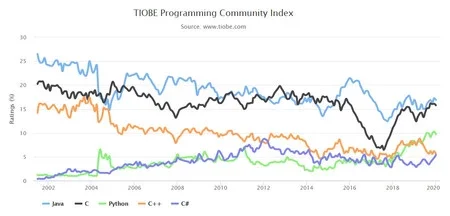
If the software development world had a thermometer, it would be the TIOBE Index. For more than two decades, this monthly ranking measures the popularity of programming languages based on millions of data points from search engines, courses, active engineers, and technology vendors. It does not measure which language is "better" or "more beautiful". It measures which one is gaining more traction, more discussion, and more presence in the global ecosystem.
In June 2026, the TIOBE data shows a fascinating scenario: Python is still the king, but its crown is shifting. New players like Rust are breaking in with historic force, while traditional languages like Java and C++ are rearranging themselves in a tight fight. All of this is happening while artificial intelligence, cloud computing, and the demand for secure software are rewriting the rules of the game.
In this article we not only analyze the June 2026 data with rigor. We go further: we apply statistics, probability, and industry trends to predict how the Top 3 of the TIOBE Index might close the year. No guesswork. We will use real data, simple models, and some informed intuition.
At the end, I invite you to participate in a free‑text poll where you can leave your own prediction: which language do you think will be number 1 in December 2026? I do not intend to defend or refute the TIOBE Index. I only use it as a reference to think about where the industry is moving.
The current scenario: June 2026 data
On June 8, 2026, TIOBE published its monthly ranking. These are the key data points that mark the starting point of our analysis.
The current Top 5 (June 2026)
1. Python – 18.96%
It drops 6.91 percentage points from the previous month. In July 2025, Python reached its all‑time high of 26.98%. Today it is almost 8 points below. The drop is real, but the gap over second place is still abysmal: more than 8 points ahead.
2. C – 10.77%
It rises 1.30 points. It recovers ground and establishes itself as the main pursuer. C has never left the podium in the entire history of the TIOBE Index.
3. C++ – 8.03%
It falls 2.65 points. It loses the second place it held in May against Java and now sits third. The difference with Java is minimal, only 0.13 points.
4. Java – 7.90%
It drops 0.94 points. But its decline is milder than C++'s, allowing it to climb one position. Java 26, recently released, seems to have given it a small breather.
5. C# – 4.85%
It rises 0.17 points. Firm in fifth place with no major surprises.
The Rust phenomenon
The big headline of the month is not in the Top 5. It is further down.
Rust reached for the first time the 12th position with a 1.26% share, up 0.30 points from the previous month. To put it in perspective: one year ago, Rust was in 20th place. In May 2026 it was 18th. In June it jumped 6 positions.
What is most surprising is that TIOBE's own CEO, Paul Jansen, had stated two months ago that Rust seemed to have entered a plateau, because it had spent an entire year without moving up. The June data made him eat his words. The combination of memory safety, performance on par with C++, and a maturing ecosystem explains this late but explosive rebound.
The forces moving the board
To predict we need to understand. It is not about looking at a chart and extrapolating lines. It is about reading the deep currents that push each language.
1. Python's decline is not a crisis, it is a maturation
Python remains the most used language in artificial intelligence, data science, and automation. No debate. But its exponential growth of recent years had to stabilize. What we are seeing is not that Python is "falling", but that the market is maturing. As Paul Jansen explains, Python's drop is not due to a single language eating its ground, but to natural fragmentation: R recovers space in advanced statistics, Perl resurges in automation, and TypeScript and Rust attract developers who would otherwise have gone to Python.
On GitHub, Python is still growing in absolute terms: it added 850,000 new contributors in 2025, a 48.78% year‑over‑year increase. The problem is that others are growing faster.
2. Rust: the perfect storm
Rust has been the "most loved" language in the Stack Overflow survey for nine consecutive years. That is not a coincidence. That is a deeply committed community. But love does not always translate into massive usage. That is changing.
In 2026, the US government and the European Union are actively pushing for the adoption of memory‑safe languages to replace C and C++ in critical infrastructure. Projects like Rust's implementation in the Linux kernel and in Windows components are undeniable signs that the language has ceased to be an academic curiosity and become a strategic bet.
In TIOBE, Rust jumped from 20th to 12th in a matter of months. The question is not whether it will continue to rise, but how much and how fast.
3. TypeScript: the invisible king
There is a fascinating paradox here. In TIOBE, TypeScript does not even appear in the Top 20. Yet on GitHub, since August 2025 TypeScript is the most used language on the entire platform, surpassing Python and JavaScript. In 2025 it added more than one million new contributors, the largest absolute growth of any language.
Why the discrepancy? TIOBE measures "popularity" in search engines and courses. TypeScript is a language that is often learned on the fly, as a "superset" of JavaScript, not as a ground‑up language. That is why its footprint in searches and courses is smaller. But in the real code written every day in millions of repositories, TypeScript is already king. If TIOBE reflects "noise", GitHub reflects "action". Both are valid, but they measure different things.
For our Top 3 prediction, TypeScript is not relevant because it is not in the upper ranks of TIOBE. But to understand where the industry is heading, it is fundamental.
4. The job market: Python and SQL, a technical tie
A recent study by Oxylabs analyzed more than 800,000 tech job postings in the US between January 2025 and March 2026. The result is revealing: Python appeared in 46% of the postings, and SQL in 45%. Java, on the other hand, appeared in only 21%, and JavaScript in 19%.
The job market does not measure popularity; it measures need. Python and SQL are the most demanded tools because they are the Swiss Army knives of data analysis and modern backend. C and C++ have demand in embedded and high‑performance systems, but their share of job postings is much smaller.
This data point is important because TIOBE popularity is correlated with job demand, but not perfectly. A language can be widely mentioned in courses (rising in TIOBE) without having massive job demand. And vice versa.
Predictive methodology: three scenarios
To project the Top 3 to December 2026 we will use three simple models. We do not need differential equations or neural networks. With linear regression, trend analysis, and a bit of common sense we will have a reasonable range.
Scenario 1: Pure inertia (linear regression)
Assume that the trends of the last 6 months remain constant. We calculate the average monthly rate of change of each language between January and June 2026 and extrapolate to December.
Python: fell from 21.81% to 18.96% in six months. That is an average drop of 0.475% per month. Projecting six more months gives 16.11% .
C: went from 11.05% to 10.77%, a very small drop. But between May and June it rose sharply (+1.30%). On average, the trend is almost flat. We project 10.50% .
C++: fell from 8.55% to 8.03% in six months. Average drop of 0.087% per month. We project 7.51%.
Java: fell from 8.12% to 7.90%. Average drop of 0.037% per month. We project 7.68%.
In this scenario, the fight for third place would be tremendous. Java (7.68%) would slightly surpass C++ (7.51%), but both would be very close. Python would win comfortably but with its lowest share in years.
Scenario 2: Acceleration of trends (industry)
Now we incorporate industry factors. Artificial intelligence continues to grow, and Python is its native language. Although the growth rate of AI moderates, the installed base remains enormous. On the other hand, regulatory pressure for safe software benefits Rust, but that affects lower ranks more.
In this scenario, Python's decline slows because AI keeps demanding professionals. Suppose the drop is halved: 0.237% per month. Python would reach 17.54% .
C and C++ remain stable due to their role in critical systems. C++ could even regain some ground if interest in Rust translates into more comparative searches. We project C at 10.80% and C++ at 8.20% .
Java would continue to decline slowly due to the generational shift toward Kotlin and other JVM languages. We project 7.50% .
In this scenario, the Top 3 would be Python, C, C++. Java would be fourth.
Scenario 3: Disruption (the Rust factor)
What if Rust keeps accelerating? In June it rose 0.30 points and 6 positions. That growth rate is unsustainable, but if it maintained significant momentum, it could approach the Top 10 by year end. Could Rust reach third place? Mathematically it is almost impossible in six months. It would need unrealistic exponential growth. But it could settle in ninth or tenth place, displacing R or SQL.
In this scenario, the Top 3 does not change: Python, C, C++. But the ecosystem below is revolutionized, which indirectly affects the perception of the Top 3 in the long term.
The probabilistic factor: what is most likely?
If we assign probabilities based on data and history, here is our summarized forecast.
First place: Python (>99% probability)
No discussion. Python's margin over second place is more than 8 points. Even if it kept falling at the current rate, it would take more than a year to lose the top spot. In December 2026, Python will still be the most popular language in TIOBE. The only doubt is how much it will have fallen.
Second place: C (≈70% probability)
C and C++ have been alternating between second and third for years. In June, C surpasses C++. The advantage is almost 3 points (10.77 vs 8.03). That gap is large and difficult to overcome in six months. Unless C++ has an unexpected rebound, the most likely outcome is that C holds second place.
Third place: Technical tie between C++ and Java (≈50% each)
Here is the real excitement. C++ and Java are separated by only 0.13 points. Java recently had a new release (Java 26) that has given it some traction. C++ remains fundamental in games, embedded systems, and high‑frequency finance. In the coming months, any news, any release, any viral trend could tip the balance.
Our prediction is that Java could regain third place toward the end of the year by a very narrow margin. But it is a coin toss. If pressed, I would give 55% to Java and 45% to C++.
Probable Top 3 by December 2026
After all the analysis, this is our most grounded prediction:
- Python – between 16% and 18% share
- C – between 10% and 11% share
- Java – between 7.5% and 8% share (very close with C++)
Is this a bold prediction? Not especially. TIOBE history teaches us that sudden changes in the Top 3 are rare. Python, C, C++, and Java have been rotating the top positions for years. What is changing is not so much the who, but the how: shares are compressing. Python goes down, C goes up, Java and C++ get closer. In a few years, the Top 3 could be completely different. But in December 2026, not yet.
The industry roadmap: beyond the Top 3
More important than the exact ranking is understanding why certain languages are rising or falling.
TypeScript: although it is not in TIOBE's Top 20, it is the de facto language for modern scalable web applications. Its growth on GitHub and in enterprise environments is unstoppable. If TIOBE measured real code written and not just searches, TypeScript would be among the top five.
Rust: the big star of 2026. For the first time, the industry is seriously considering replacing C and C++ in critical systems. Rust offers memory safety without a garbage collector, making it ideal for kernels, browsers, and embedded systems. The learning curve remains steep, but once overcome, productivity is extremely high. In 2027 or 2028, Rust could be in the consolidated Top 10.
Go: Google's language remains the favorite for cloud infrastructure and microservices. Its simplicity and excellent concurrency performance keep it in the Top 15, but without major changes.
Kotlin: it remains king on Android, but outside that niche its growth has stagnated. In June 2026, Kotlin fell out of the Top 20 for the first time in years. JetBrains is betting heavily on Kotlin Multiplatform to reverse this trend. We will have to see.
Your turn: what will be the number 1 in December?
Predictions are fun, but reality is built by all of us. I want to know what the CodeWithBotina community thinks. Do you think Python will comfortably keep the throne? Or do you think C could surprise? Maybe Rust climbs faster than we imagine?
Participate in the free‑text poll. Write your prediction for the first place in the TIOBE Index at December 2026. You can write a language, a percentage, an analysis, or just your intuition. There are no right answers. Only curiosity and community.
Poll:
Closing
The TIOBE Index is not an absolute truth. It is a photograph, a snapshot of what the community is searching for and discussing. Ignoring it would be naive. Taking it as dogma would also be naive. Intelligence lies in balance: using it as one more tool to understand where the wind is blowing.
In 2026, the wind is blowing in favor of Python, C, and Java at the top. But below, the storm is changing. TypeScript, Rust, and other younger languages are redrawing the map. In a few years, the Top 3 could be completely different. But in December 2026, the order will be very similar to today. Tectonic changes take more than six months.
Thank you for reading this far. Now go and leave your prediction. The future of software is written by all of us.
References
TIOBE Software. (2026). TIOBE Index for June 2026. https://www.tiobe.com/tiobe-index/
IT. (2026, June 8). TIOBE 2026 6 Rust 12. https://www.ithome.com/0/961/275.htm
Sohu. (2026, June 8). TIOBE 2026 6. https://www.sohu.com
TechRepublic. (2026, May 13). TIOBE Index for May 2026: R Ascends as Statistical Tools Consolidate. https://www.techrepublic.com
Medium / iThome. (2026, February 11). TIOBE Python. https://it.nycu.edu.tw
Oxylabs. (2026, June 4). New Research: SQL Rivals Python as America’s Most In-Demand Programming Language. https://www.globenewswire.com
GitHub Blog. (2026, February 3). What the fastest-growing tools reveal about how software is being built. https://github.blog
Blockchain.News. (2026, February 4). TypeScript Overtakes Python as GitHub's Top Language Amid AI Coding Boom. https://blockchain.news
Stack Overflow. (2025). Stack Overflow Developer Survey 2025. https://stackoverflow.com
Python.org. (2026, April). Python Software Foundation. https://www.python.org
Rust Foundation. (2026). Rust State of the Ecosystem 2026. https://rust-foundation.org
Loading reactions...
Comments (0)
Loading session...
No comments yet. Be the first to comment.