When official discourse clashes with reality: a testimony on Petrism and rural Colombia
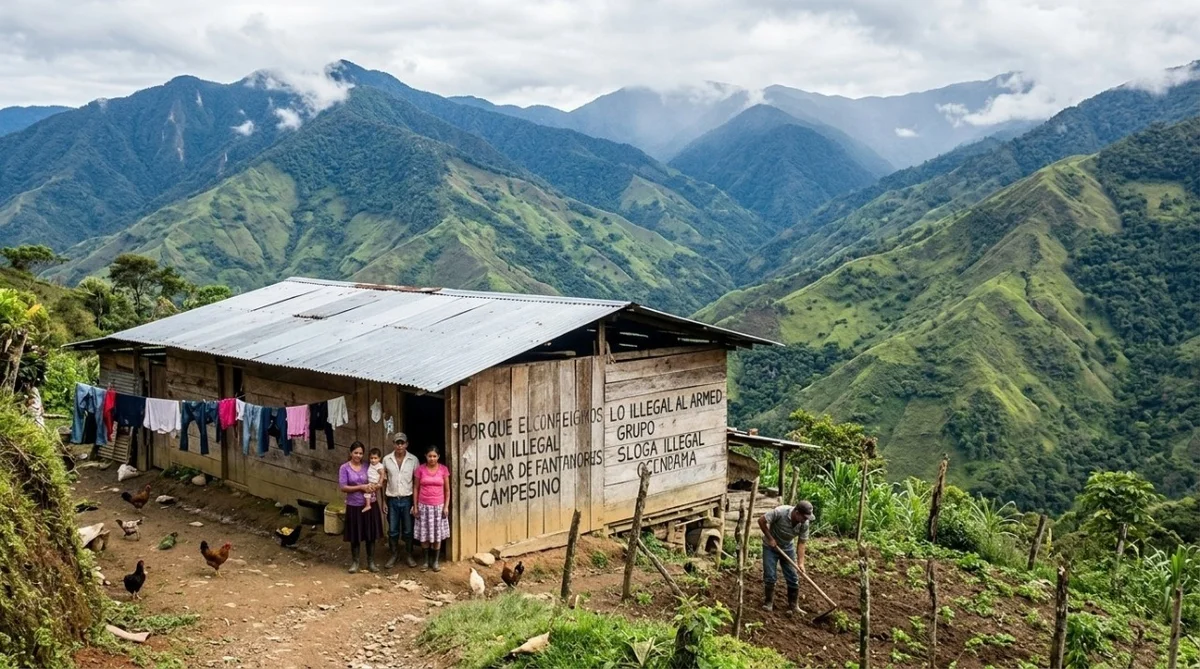
"Every snitch, informant, disobedient person, and anyone who does not accept orders will be shot."
That sentence was not written by a novelist. It did not come from a movie. It was written by the FARC dissidents in a communiqué directed at a farming community, and the person who showed it to me — whom I will call Juan, a fictitious name to protect his identity — celebrated it as if it were good news. That moment, that conversation, is what has led me to write these lines.
This is not an opinion piece in the traditional sense. It is an account of what I saw and heard with my own ears during a few days in a rural area of Colombia, contrasted with verifiable facts documented by national and international media outlets. I do not intend to convince anyone of anything. I simply want to put on the table a reality that, for those of us who live in cities, sometimes becomes abstract: life in the Colombian countryside, under the shadow of armed groups, continues to be a life of fear, of threats, and of forced silence. And it is deeply painful that there are those who, from the comfort of a political discourse, celebrate that silence.
The context: violence that does not cease
Colombia has spent decades trying to build peace, and every attempt has crashed against the same wall: illegal armed groups do not negotiate in good faith. During Gustavo Petro's government, the "Total Peace" policy was implemented, an ambitious attempt to dialogue with all armed actors. However, the results have not been as expected. In fact, various analyses agree that violence has not decreased; in some cases, it has worsened.
An Insight Crime article from January 2026 notes that "in 2025, Colombia experienced levels of violence not seen in years, as a result of disputes between criminal groups, militarily and..." The academic publication La política de la paz total en Colombia. ¿Ha... concludes that "after three years, the balance of Total Peace is not encouraging, as it has faced serious political, legal, and institutional difficulties." The reality is that the "Total Peace" policy generated more expectations than transformative results, and the growth of armed organizations has not stopped.
The numbers back up this concern. In 2024, the ELN committed 86 terrorist actions between August 3 and October 22, after breaking the ceasefire. On September 17, 2024, this same group attacked a military base in Puerto Jordán, Arauca. That same year, in the municipality of Taminango, Nariño, a car bomb left three dead and nine wounded. And in June 2024, drone and car bomb attacks were recorded in the departments of Cauca and Valle del Cauca.
2025 was no better. In December of that year, the ELN perpetrated an attack on a military base in Aguachica, Cesar, where seven soldiers died and 31 were wounded. The guerrilla group also announced four armed strikes in 2025, the last of which was nationwide. Violence is not an invention of the opposition. It is a reality lived firsthand in the territories.
The communiqué that chilled my blood
During my stay in that rural area, someone showed me a communiqué from the FARC dissidents. I cannot reveal specific details to protect the people involved, but the content was clear and chilling: it threatened to shoot anyone considered a "snitch," informant, or disobedient person. "Every snitch, informant, disobedient person, and anyone who does not accept orders will be shot," the text said. And Juan, the farmer who filled his mouth defending Petrism, celebrated it: "If this were applied nationwide, Colombia would be a 'beauty,'" he told me.
That sentence left me frozen. I could not believe that anyone could celebrate a death threat, a summary judgment handed down by an illegal armed group. But then I understood something: Juan is not evil. Juan is a person who has lived so long in that environment of fear and violence that he has normalized the unacceptable. He has been living alone in that rural area for three years, not his whole life like other farmers there. Perhaps because he did not grow up there, he adopted with more fervor the discourse that justifies the territorial control of armed groups as a form of "order."
But the fact that someone normalizes it does not mean it is right. We cannot allow fear and habit to make us accept that an illegal armed group dictates who lives and who dies in any corner of Colombia.
The complicit silence of a dangerous discourse
One of the most worrying aspects of Petrism is how, from the official discourse, the seriousness of the security situation has been downplayed. It has been said that "insecurity" is an invention of the opposition, that the country is safer than ever. But the facts prove otherwise. And what is worse, "total peace" has been called a strategy that, in practice, has granted legitimacy and power to terrorist groups without demanding anything in return.
The accusation is serious: organizations like INDEPAZ have documented massacres and murders of social leaders that do not cease. And what is most unsettling is that, from the government, attacks have been labeled as "unacceptable," but concrete actions to stop them have been limited. As an analysis from the University of Navarra points out, "the government found itself in a situation that has overwhelmed it and its responses have been limited and without results."
What I experienced in that rural area is a microcosm of what happens in many regions of Colombia: armed groups impose their law, threaten the population, and, unfortunately, find an echo in those who, from an ideological position, justify or minimize their actions. One cannot speak of "total peace" when farmers live under the threat of execution. One cannot speak of "security" when terrorist groups feel they have the authority to give orders and punish those who disobey them. And one cannot allow a political discourse to turn into "beauty" what is, in reality, a territorial dictatorship.
A call for reflection
This article is not an attack on a political ideology. It is a call for reflection, from direct experience and verifiable facts. It is not about being right‑wing or left‑wing. It is about being Colombian and not accepting that any armed group, under any flag, has the right to threaten a farmer with death for not obeying its orders.
Juan, the farmer who celebrated the communiqué, is not my enemy. He is a reflection of what prolonged violence can do to the human mind: normalize the unacceptable. But we cannot allow that normalization to become state policy. The Colombian state must regain control of its territory, must protect its citizens, and cannot, under any circumstances, negotiate with terrorist groups from a position of weakness that strengthens them.
Peace is not built with empty speeches or concessions to those who sow terror. Peace is built with facts, with effective state presence, and with the guarantee that no Colombian will have to live in fear of being shot for not accepting the orders of an illegal armed group. Because, as a farmer once said in a conversation I will never forget: "Peace is not them giving us orders. Peace is being able to live without anyone ordering us to kill."
References
The following sources support the information presented in this article.
- Ambos, K. (2026). La política de la paz total en Colombia. ¿Ha... Revista Científicus.
- Blu Radio. (2025, December 15). ELN incrementa acciones terroristas en el país por el paro armado. https://www.bluradio.com
- El Tiempo. (2024, June 8). Presidente Gustavo Petro tras atentados terroristas en Cauca y Valle: 'La orden es neutralizar al Emc'. https://www.eltiempo.com
- Infobae. (2024, May 21). Ministerio de Defensa publicó el cartel de los jefes guerrilleros que atacaron en el Cauca y el Valle. https://www.infobae.com
- Infobae. (2026, June 11). Disidencias de las Farc se atribuyeron masacre de cuatro campesinos en Remedios, Antioquia: "Eran informantes". https://www.infobae.com
- Insight Crime. (2026, January 5). El laberinto sin salida de la Paz Total en Colombia. https://insightcrime.org
- RCN Radio. (2024, October 22). ELN cometió 86 acciones terroristas en Colombia, después de la ruptura del cese el fuego. https://www.rcnradio.com
- Semana. (2024, October 6). "La paz total es un verdadero fiasco": fuerte crítica al gobierno tras nuevas masacres. https://www.semana.com
- Spanish.people.com.cn. (2025, December 20). Al menos 7 soldados mueren por ataque de guerrilla ELN en base militar colombiana. https://spanish.people.com.cn
- Spanish.news.cn. (2024, June 23). Atentado de coche bomba deja 3 muertos y 9 heridos en sur de Colombia. https://spanish.news.cn
- Universidad de Navarra. (n.d.). Sin 'Paz Total': Fuerte recrudecimiento de la violencia en... https://www.unav.edu
- Wikipedia. (n.d.). Atentado en Arauca de 2024. https://es.wikipedia.org
Author's note
Names and specific location details have been modified to protect the identity and safety of the people involved. However, the facts and dates cited are verifiable through the journalistic and academic sources mentioned.
Loading reactions...
Comments (0)
Loading session...
No comments yet. Be the first to comment.